Introduction
Friendship is one of the most meaningful forms of connection. Friends witness your growth, support you through change, challenge your perspective, celebrate your wins, and sometimes understand parts of you that even family or romantic partners may not fully see.
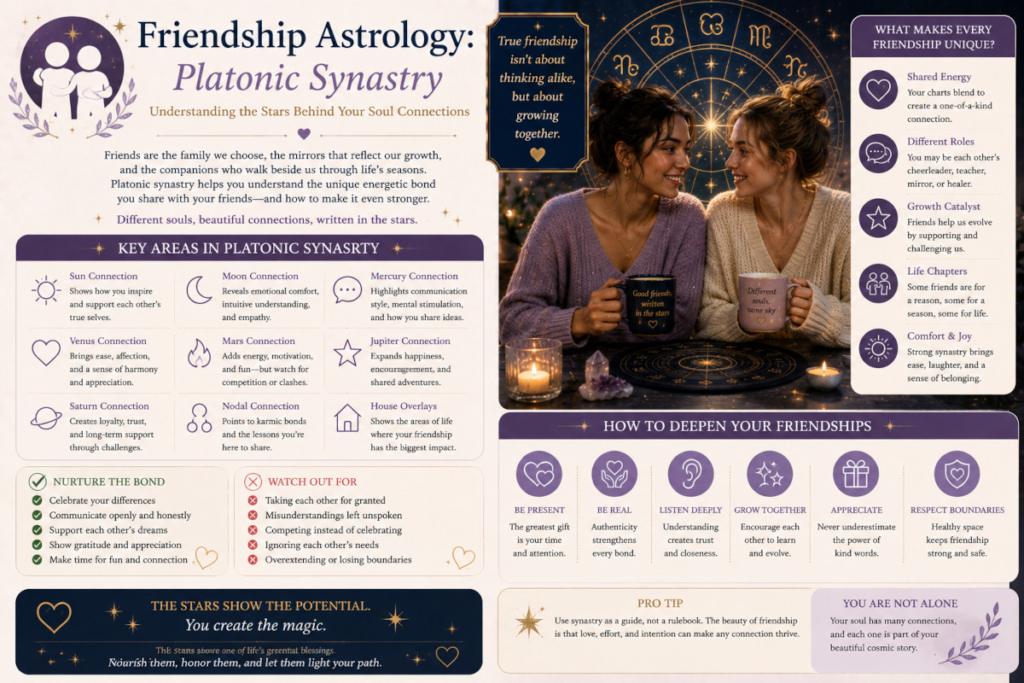
Astrology is often used to explore romance, but it can be just as useful for understanding friendship. Platonic synastry looks at how two birth charts interact in a friendship rather than a romantic relationship. It helps explain why some friends feel instantly familiar, why some friendships are mentally exciting, why others feel emotionally safe, and why certain connections last through many seasons of life.
A friendship chart does not tell you whether someone is a “good” or “bad” friend. It does not replace effort, communication, trust, shared experiences, or mutual respect. But it can reveal the natural rhythm of a friendship: how you communicate, what kind of support you offer each other, where you grow together, and where differences may require patience.
Friendship astrology reminds us that not every meaningful bond has to be romantic. Some of the most important soul connections are platonic.
What Is Platonic Synastry?
Platonic synastry is the comparison of two birth charts to understand friendship dynamics. It uses the same basic method as romantic synastry, but the focus changes.
In romantic synastry, astrologers often look closely at attraction, passion, long-term partnership, intimacy, and relationship chemistry. In friendship synastry, the most important themes are emotional support, communication, shared values, mutual enjoyment, growth, loyalty, and social connection.
For friendship, Moon connections show emotional understanding. Mercury connections show conversation style and mental compatibility. Venus connections show shared values and the kind of activities that feel enjoyable together. Jupiter connections show encouragement, adventure, and growth. Saturn connections show loyalty, consistency, and the ability to stay connected over time.
Platonic synastry answers questions like:
- Why does this friend feel emotionally safe?
- Why do we talk so easily?
- What kind of support do we naturally give each other?
- Why does this friendship feel inspiring, serious, playful, or intense?
- Where might misunderstandings happen?
- What helps this friendship last?
The purpose is not to judge the friendship. The purpose is to understand it more consciously.
Friendship Synastry vs. Romantic Synastry
Friendship synastry and romantic synastry use many of the same symbols, but they read them through different priorities.
In romance, Venus and Mars may become central because they can show attraction, desire, and romantic chemistry. The 5th, 7th, and 8th houses may receive special attention because they relate to romance, partnership, intimacy, and shared emotional depth.
In friendship, the emphasis shifts. The 11th house becomes especially important because it rules friendship, community, groups, social belonging, and shared hopes. The 3rd house can show conversation and everyday connection. The 5th house can show fun and creativity. The 9th house can show shared beliefs, travel, learning, and big-picture thinking.
In a friendship reading, the key question is not “Are we romantically compatible?” The better question is: “What kind of friendship do we create, and how do we support each other’s lives?”
This difference matters because not all strong synastry is romantic. Two people can have powerful Moon, Mercury, Venus, Jupiter, or Saturn connections and experience them as deep friendship, mentorship, creative partnership, or chosen-family energy.
The Moon in Friendship: Emotional Safety and Support
The Moon is one of the most important placements in friendship astrology. It shows emotional needs, comfort patterns, instinctive reactions, and how someone gives or receives care.
When two friends have supportive Moon connections, the friendship may feel emotionally natural. You may understand each other’s moods without needing long explanations. You may feel safe being vulnerable, tired, imperfect, or honest. The friendship may have a sense of emotional familiarity, even if you have not known each other for very long.
Moon connections can also show the type of support a friend provides. Some friends help you process feelings. Some make you laugh when you are overwhelmed. Some offer practical help. Some remind you to be brave. Different Moon styles support in different ways.
Moon Elements and Friendship Style
Water Moon friends, including Cancer Moon, Scorpio Moon, and Pisces Moon, often bring emotional depth, intuition, tenderness, and a safe space for vulnerability. They may notice emotional changes quickly and support friends through deep conversations or quiet presence.
Earth Moon friends, including Taurus Moon, Virgo Moon, and Capricorn Moon, often offer reliable and practical care. They may show love by helping with real problems, remembering details, staying consistent, and being present when life becomes difficult.
Air Moon friends, including Gemini Moon, Libra Moon, and Aquarius Moon, often provide perspective, conversation, humor, social connection, and mental clarity. They may help friends think through emotions and see situations from a new angle.
Fire Moon friends, including Aries Moon, Leo Moon, and Sagittarius Moon, often bring encouragement, energy, honesty, confidence, and celebration. They may help friends take action, regain courage, or remember joy after a hard season.
No Moon element is better than another. Each one offers a different kind of friendship medicine.
Challenging Moon Connections in Friendship
Not all Moon connections are easy. Challenging Moon aspects can show different emotional languages. One friend may need deep emotional processing, while the other prefers action. One may want reassurance, while the other needs space. One may express feelings openly, while the other becomes quiet under stress.
These differences can cause misunderstandings if both people assume their emotional style is the only correct one.
However, challenging Moon connections can also create growth. Friends can learn emotional flexibility from each other. The key is to respect different support needs instead of taking them personally.
A friend who offers practical solutions may not be uncaring. A friend who needs emotional depth may not be dramatic. A friend who needs humor may not be avoiding everything. A friend who needs silence may not be rejecting you.
Moon awareness helps friends support each other in ways that actually help.
Mercury in Friendship: Conversation, Humor, and Understanding
Mercury shows communication, thinking style, humor, curiosity, learning, and the way people exchange ideas. In friendship, Mercury is essential because many friendships are built through conversation.
Strong Mercury synastry can make a friendship feel easy and lively. You may talk for hours, finish each other’s thoughts, share jokes, exchange ideas, or feel mentally understood. Some friendships survive long distances because the communication itself keeps the bond alive.
Mercury also shows how friends handle disagreement. Do you talk things through? Do you debate? Do you avoid hard conversations? Do you need directness, softness, detail, humor, or time to think?
A strong friendship does not require identical communication styles. But it does require enough understanding to avoid repeated misinterpretation.
Mercury Elements and Friendship Communication
Earth Mercury friends tend to communicate practically. They may appreciate details, plans, useful advice, and clear examples. They often help friends organize thoughts and turn ideas into action.
Air Mercury friends tend to communicate through curiosity, ideas, humor, and variety. They may enjoy long conversations, intellectual exploration, and social topics. They often bring freshness and perspective.
Fire Mercury friends tend to speak directly and enthusiastically. They may encourage action, tell bold truths, and bring motivational energy to conversations. Their honesty can be refreshing, though sometimes intense.
Water Mercury friends tend to communicate intuitively and emotionally. They may understand tone, mood, and hidden meaning. They often bring sensitivity and depth to conversations.
When Mercury styles differ, friends may need translation. One person’s directness may need more gentleness. Another person’s indirectness may need more clarity. Good friendship communication grows through adaptation.
Venus in Friendship: Shared Values and Enjoyment
Venus is often associated with romance, but it is also important in friendships. Venus shows what people enjoy, value, appreciate, and find beautiful or meaningful. In platonic synastry, Venus can reveal why two friends simply like being around each other.
Strong Venus connections can make friendship feel pleasant, warm, harmonious, and easy to enjoy. Friends may share taste in music, food, art, aesthetics, social activities, or lifestyle preferences. They may naturally know how to make each other feel appreciated.
Venus also shows friendship values. Some people value loyalty and consistency. Others value freedom and variety. Some prefer deep one-on-one bonding. Others enjoy social groups and lighthearted fun.
Understanding Venus helps friends avoid judging each other’s friendship style.
Venus Elements and Friendship Values
Earth Venus friends may value stability, quality time, loyalty, practical support, and consistency. They may enjoy shared meals, peaceful routines, thoughtful gifts, or dependable friendship rituals.
Air Venus friends may value conversation, social variety, ideas, openness, and shared curiosity. They may enjoy events, group settings, cultural experiences, and playful intellectual connection.
Fire Venus friends may value excitement, confidence, authenticity, celebration, and spontaneous fun. They may enjoy adventures, creative risks, bold plans, and friendships that feel alive.
Water Venus friends may value emotional depth, tenderness, privacy, trust, and loyalty. They may prefer intimate conversations, meaningful gestures, and friendships that feel emotionally sincere.
When Venus styles align, friendship can feel naturally enjoyable. When they differ, friends may need to balance different ways of showing appreciation.
Jupiter in Friendship: Growth, Joy, and Possibility
Jupiter shows growth, optimism, learning, adventure, generosity, and the way people expand each other’s world. In friendship astrology, Jupiter often describes friends who make life feel bigger.
A strong Jupiter connection can bring laughter, encouragement, travel, learning, shared dreams, spiritual exploration, or the courage to try new things. Jupiter friends often remind you that life has possibilities beyond your current limits.
Some Jupiter friendships are adventurous. Others are intellectual, spiritual, creative, or emotionally healing. The main theme is expansion.
Jupiter can also show where friends overdo things together. Too much Jupiter may create excess, unrealistic plans, overspending, overpromising, or avoiding difficult realities because the friendship feels so positive.
Healthy Jupiter friendship inspires growth without losing grounding.
Saturn in Friendship: Loyalty, Time, and Endurance
Saturn is one of the most important planets for long-term friendship. It shows commitment, responsibility, boundaries, consistency, maturity, and the ability to remain present through time.
Strong Saturn connections can make a friendship feel serious, loyal, dependable, or enduring. These are the friends who may stay through life changes, distance, pressure, or difficult seasons. Saturn friendships may not always feel light, but they can become deeply trustworthy.
Saturn can also bring challenges. A friendship may feel heavy if one person always becomes the responsible one. There may be pressure, criticism, distance, or fear of disappointing each other. Sometimes Saturn friendships require patience because they grow slowly.
When handled well, Saturn teaches friends how to show up. It reminds us that friendship is not only shared fun. It is also maintenance, responsibility, repair, and loyalty.
The Sun in Friendship: Identity and Mutual Recognition
The Sun represents identity, confidence, vitality, and the sense of being seen. In friendship synastry, Sun connections can show how two people support each other’s self-expression.
Strong Sun connections may create mutual recognition. You may feel that a friend understands who you are becoming. They may encourage your confidence, creativity, leadership, or authenticity.
A friend’s planets touching your Sun can make you feel noticed. This can be empowering, but it can also bring ego sensitivity if the friendship becomes competitive or one person feels overshadowed.
Healthy Sun friendships help both people shine. They do not require one person to become smaller so the other can feel bright.
Mars in Friendship: Energy, Motivation, and Conflict
Mars shows action, motivation, courage, conflict, and physical energy. In friendship, Mars connections can show what friends like to do together and how they handle friction.
Strong Mars connections may create active friendships. These friends may exercise together, travel, work on projects, compete, start initiatives, or motivate each other to take action.
However, Mars can also bring irritation, impatience, or rivalry. Friends with challenging Mars aspects may trigger each other quickly. Small differences can become arguments if neither person slows down.
Mars in friendship is best when the energy has a shared direction. Instead of turning against each other, friends can use Mars for courage, creativity, movement, and mutual motivation.
The Nodes in Friendship: Familiarity and Life Lessons
The lunar nodes can show meaningful friendship patterns. Node connections may create a sense of familiarity, timing, or importance. A friend may feel like someone you were meant to meet because the connection activates a growth path.
South Node connections can feel familiar and comfortable. They may bring people together through shared history, similar emotional patterns, or a feeling of having known each other before. However, they can also repeat old habits if both people stay in comfort zones.
North Node connections can feel growth-oriented. A friend may encourage you to become braver, more honest, more independent, more expressive, or more aligned with your future.
Not every nodal friendship is easy, but these connections can be meaningful teachers.
House Overlays in Friendship
House overlays show which areas of life a friend activates in your chart. In friendship astrology, the 11th house is especially important, but several houses can shape platonic bonds.
The 11th house is the house of friendship, community, networks, social belonging, and future hopes. When someone’s planets fall in your 11th house, they may naturally feel like a friend, teammate, community connection, or person who expands your social world.
The 3rd house relates to communication, learning, siblings, neighbors, local life, and everyday exchange. Planets here can create friendships built through conversation, regular contact, shared curiosity, or local community.
The 5th house relates to creativity, joy, play, self-expression, hobbies, and fun. Planets here can create friendships full of laughter, art, entertainment, and shared recreation.
The 9th house relates to travel, philosophy, spirituality, education, and big-picture thinking. Planets here can create friendships based on learning, shared beliefs, exploration, or broadening each other’s worldview.
The 4th house can create chosen-family energy. The 8th house can create emotional depth and trust. The 10th house can connect friends through career, visibility, or mentorship.
House overlays help explain where a friendship lives in your life.
Different Types of Astrological Friendships
Not every friend serves the same role. Astrology can help you recognize the different kinds of support your friendships provide.
The Soul Friend
The soul friend feels emotionally meaningful. This friendship may include strong Moon, water sign, 4th house, 8th house, or 12th house themes. You may share deep conversations, emotional healing, spiritual understanding, or a sense of quiet recognition.
This friend may be the one you call when you need honesty, comfort, or a safe place to be vulnerable.
The Intellectual Friend
The intellectual friend activates your mind. This friendship may include strong Mercury, air sign, 3rd house, 9th house, or 11th house themes. You may share ideas, books, theories, debates, jokes, or endless conversations.
This friend helps you think differently and stay curious.
The Adventure Friend
The adventure friend expands your world. This friendship may include strong Jupiter, fire sign, 5th house, 9th house, or 11th house themes. You may travel together, try new activities, take creative risks, or encourage each other to grow.
This friend reminds you that life can still surprise you.
The Loyal Friend
The loyal friend brings steadiness. This friendship may include strong Saturn, earth sign, 4th house, 10th house, or 11th house themes. This person may not always be the loudest presence, but they are consistent, dependable, and trustworthy.
This friend shows that love can be quiet and still very strong.
The Creative Friend
The creative friend awakens play, art, humor, and self-expression. This friendship may include strong 5th house, Venus, Neptune, or Sun themes. You may create together, inspire each other aesthetically, or feel more alive in each other’s presence.
This friend helps you remember joy.
Friendship Challenges Through Astrology
Challenging synastry does not mean a friendship is doomed. It simply shows where awareness is needed.
Mercury challenges may create communication differences. One friend may prefer direct facts while another speaks emotionally or abstractly. Misunderstandings may happen when tone, timing, or style is not respected.
Moon challenges may create emotional support differences. One friend may need deep conversation while another offers practical solutions or distraction. Both forms of support can be loving, but they may not always meet the need of the moment.
Venus challenges may create different friendship values. One person may prefer consistency and one-on-one time, while another prefers variety and group connection. One may show appreciation through gifts, while another shows it through words, time, or shared experiences.
Mars challenges may create friction, competition, or impatience. Saturn challenges may create distance, pressure, or feelings of obligation. Jupiter challenges may create mismatched expectations around growth, fun, or risk.
The solution is not to force sameness. It is to understand difference and build friendship agreements that respect both people.
How to Use Friendship Astrology in Real Life
Friendship astrology becomes useful when it helps you become a better friend. It should not be used to rank people, label them, or decide that a connection is worthless because one aspect looks difficult.
Start by understanding your own friendship needs. Look at your Moon for emotional support, Mercury for communication, Venus for enjoyment and values, Jupiter for growth, Saturn for loyalty, and the 11th house for friendship patterns.
Then reflect on your real friendships. Which friends help you feel emotionally safe? Which friends make you think? Which friends bring fun? Which friends help you grow? Which friends stay consistent when life is difficult?
You may realize that different friends meet different needs. One person does not have to be everything. A healthy social life can include emotional friends, intellectual friends, creative friends, loyal friends, and adventure friends.
This perspective can reduce pressure and increase appreciation.
Creating a Balanced Friendship Circle
A balanced friendship circle includes different types of support. Some friends help you process emotions. Some help you laugh. Some help you make practical decisions. Some challenge your thinking. Some encourage your dreams. Some simply sit beside you when words are not needed.
Astrology can help you see whether your friendship circle is balanced or whether you rely too heavily on one type of connection.
If you only choose intense emotional friendships, you may need more lightness. If you only choose social friends, you may need more depth. If you only choose practical friends, you may need more inspiration. If you only choose adventure friends, you may need more consistency.
The goal is not to collect people like categories. The goal is to honor the many ways friendship can nourish your life.
Friendship Timing and Transits
Transits can influence friendship seasons. Some periods bring new social connections. Others test loyalty, reveal misalignment, or invite reconnection with old friends.
Jupiter transits may expand social life, bring new communities, or inspire shared adventures. Saturn transits may test friendship responsibility, boundaries, distance, or commitment. Venus transits may bring harmony, reconciliation, or appreciation. Mercury transits may highlight communication, messages, misunderstandings, or meaningful conversations.
Lunar phases can also be useful for friendship rituals. A New Moon may support setting intentions for community. A Full Moon may reveal friendship emotions or bring clarity. A waning Moon may help release resentment or outdated social patterns.
Timing does not control friendship, but it can help you approach important conversations and social choices with more awareness.
Friendship Boundaries and Emotional Responsibility
Good friendship requires boundaries. Even strong synastry cannot keep a friendship healthy if one person overgives, avoids honesty, or expects the other to meet every emotional need.
Astrology can show natural support styles, but real friendship still requires communication. If you need space, say so kindly. If you need emotional support, ask directly. If a friendship feels one-sided, name the imbalance. If a friend is going through a difficult period, support them without abandoning your own limits.
Boundaries do not weaken friendship. They protect it from resentment.
A healthy friendship allows both people to be human. It includes care, but not constant emotional responsibility for each other’s lives.
Privacy and Friendship Synastry
Friendship astrology often uses sensitive information, including birth details, emotional patterns, relationship history, and personal reflections. This information should be treated with respect.
Before analyzing a friend’s chart, it is thoughtful to consider consent, especially if the reading will include personal or vulnerable themes. Birth data and chart interpretations should not be used to gossip, judge, pressure, or control someone.
Digital tools can make synastry easy, but privacy still matters. If you use an astrology app or platform, check how data is stored, protected, shared, and deleted.
The most ethical use of friendship astrology is self-awareness and mutual understanding. It should strengthen trust, not invade it.
Common Mistakes in Friendship Synastry
One common mistake is reading friendship synastry exactly like romantic synastry. Platonic bonds have different priorities. Attraction markers are less important than emotional support, communication, shared values, social connection, and loyalty.
Another mistake is assuming easy aspects are always better. Easy synastry can feel comfortable, but challenging aspects may create growth, perspective, and balance.
A third mistake is expecting one friend to meet every need. Astrology can reveal why different friends play different roles. This can help you appreciate each connection for what it is instead of forcing it to become something else.
It is also a mistake to use astrology as a final verdict. Friendship is built through time, effort, kindness, trust, and shared history. A chart may explain patterns, but behavior matters most.
How to Strengthen Friendships With Astrology
Use astrology to become more attentive. If your friend has a water Moon, emotional presence may matter more than quick advice. If your friend has an earth Venus, consistency may feel like love. If your friend has an air Mercury, thoughtful conversation may help them feel connected. If your friend has strong Saturn, loyalty and follow-through may mean more than dramatic gestures.
You can also use astrology to plan meaningful friendship rituals. Celebrate friendship anniversaries. Check in during difficult transits. Share reflections during lunar phases. Choose activities that match the friendship’s energy.
Most importantly, let astrology increase gratitude. Every friend brings a different gift. Some bring warmth. Some bring truth. Some bring courage. Some bring calm. Some bring laughter. Some bring wisdom.
When you understand the gift, you can value the friendship more fully.
Frequently Asked Questions
What are the most important planets in friendship synastry?
The Moon, Mercury, Venus, Jupiter, and Saturn are especially important. The Moon shows emotional support, Mercury shows communication, Venus shows shared values and enjoyment, Jupiter shows growth and encouragement, and Saturn shows loyalty and long-term friendship potential.
Is friendship synastry different from romantic synastry?
Yes. Friendship synastry uses the same chart comparison method, but the focus is different. Romantic synastry often emphasizes attraction, partnership, and intimacy, while friendship synastry emphasizes emotional support, conversation, shared values, social connection, growth, and reliability.
Can challenging synastry still create a good friendship?
Yes. Challenging synastry can show differences in emotional needs, communication styles, values, or timing, but it can also create growth and balance. A friendship can thrive when both people respect differences and communicate honestly.
Which houses matter most for friendship astrology?
The 11th house is the most direct friendship house because it relates to friends, community, groups, and shared hopes. The 3rd house supports communication and everyday connection, the 5th house supports fun and creativity, and the 9th house supports learning, travel, and shared beliefs.
Can astrology help me understand what kind of friend I am?
Yes. Your Moon can show how you offer emotional support, Mercury can show how you communicate, Venus can show what you value in friendship, Jupiter can show how you encourage growth, and Saturn can show your loyalty and commitment style.
Conclusion
Friendship astrology reveals that platonic bonds can be just as rich, complex, and meaningful as romantic ones. Through platonic synastry, you can understand why certain friends feel emotionally safe, why some conversations flow easily, why some friendships inspire growth, and why others become steady anchors over time.
The Moon shows emotional support. Mercury shows communication. Venus shows shared values and enjoyment. Jupiter shows expansion and adventure. Saturn shows loyalty and endurance. House overlays show where the friendship lives in your life.
Still, astrology is only one part of the story. A friendship becomes meaningful through presence, effort, trust, honesty, repair, laughter, and care.
Used wisely, friendship astrology does not reduce people to chart placements. It helps you appreciate the unique role each friend plays. Some friends are mirrors. Some are teachers. Some are companions. Some are chosen family.
The most powerful friendships are not always perfect in synastry. They are the ones where both people choose understanding, respect, and connection again and again.