Introduction
Conflict is a natural part of every relationship. Even the most loving couples, friends, family members, and partners face moments of tension, misunderstanding, or emotional distance. The real question is not whether conflict happens, but how people respond when it does.
Astrology can offer a useful language for understanding conflict. It does not replace honesty, communication, responsibility, or emotional maturity. But it can help explain why two people may react so differently to the same situation.
One person may want to talk immediately. Another may need time alone first. One person may express anger directly. Another may shut down, become quiet, or speak indirectly. These differences can easily feel personal, but astrology shows that many conflict patterns come from deeper emotional and communication styles.
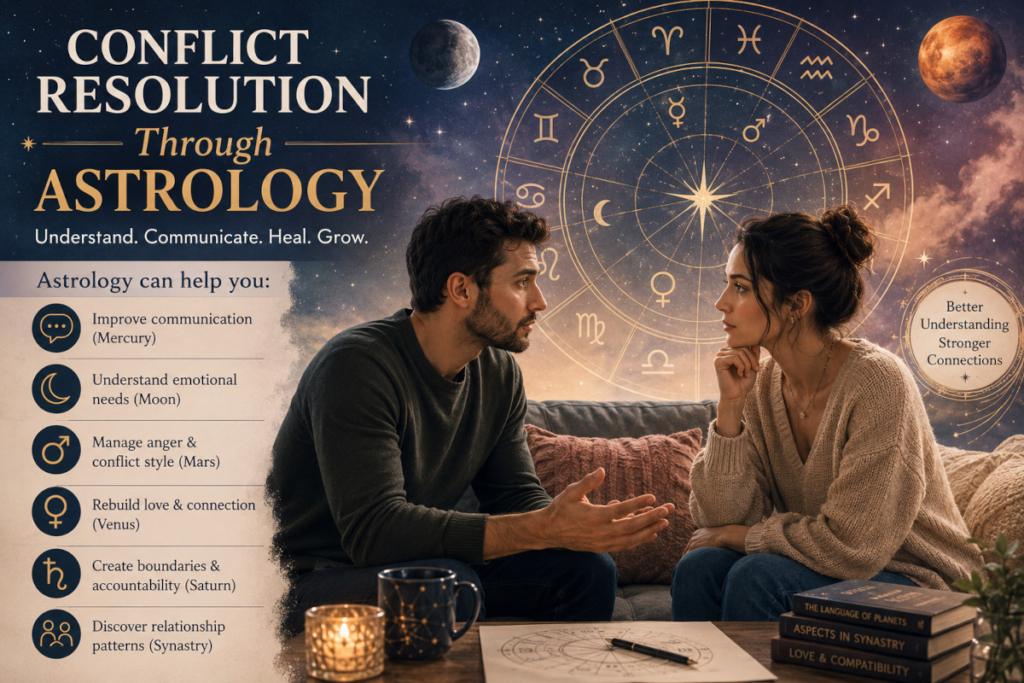
By understanding Mercury, Moon, Mars, Venus, Saturn, and synastry patterns, you can approach conflict with more patience and less blame. Astrology helps you ask better questions: What does this person need to feel safe? How do they process emotion? What makes them defensive? What kind of resolution actually feels meaningful to them?
Conflict becomes easier to navigate when both people stop trying to win and start trying to understand.
Why Astrology Helps in Conflict Resolution
Astrology reveals patterns that often stay hidden during emotional disagreements. When people are upset, they usually focus on what was said or done. But underneath the surface, there are deeper needs: safety, respect, fairness, loyalty, space, honesty, or reassurance.
A birth chart can show how someone communicates, reacts emotionally, handles anger, protects themselves, and defines love. This can make conflict less confusing.
For example, someone with strong fire energy may prefer direct and immediate conversation. Someone with strong water energy may need emotional safety before they can speak clearly. Someone with earth energy may want practical solutions, while someone with air energy may need discussion, logic, and perspective.
None of these styles are wrong. Problems begin when people assume their own style is the only correct one.
Astrology helps you see that different conflict styles are not always signs of disrespect or incompatibility. Sometimes they are simply different emotional languages.
Mercury: How We Communicate During Conflict
Mercury represents communication, thinking, listening, and the way we explain ourselves. In conflict, Mercury shows how a person processes information and what kind of conversation helps them feel understood.
A person with strong earth Mercury energy may prefer calm, practical, detailed conversations. They may want facts, examples, and clear next steps. Emotional chaos can feel overwhelming to them, so they may focus on solutions rather than feelings.
A person with strong air Mercury energy may want to talk things through from many angles. They may ask questions, analyze motives, and look for fairness. However, they may sometimes seem detached if the other person needs more emotional warmth.
A person with strong fire Mercury energy may speak quickly, directly, and passionately. They usually prefer honesty over subtlety. Their strength is courage, but their words can sometimes feel too sharp or impatient.
A person with strong water Mercury energy may communicate through emotion, intuition, and tone. They may need reassurance before they can fully open up. If they feel judged or unsafe, they may become indirect, quiet, or defensive.
Understanding Mercury can prevent many misunderstandings. Instead of thinking, “They do not care,” you may realize, “They process conflict differently than I do.”
The Moon: Emotional Needs and Triggers
The Moon shows emotional needs, instinctive reactions, and what makes a person feel safe or unsafe. During conflict, the Moon often speaks louder than logic.
When someone’s Moon is triggered, they may not respond from reason. They may respond from fear, hurt, protection, or old emotional memory.
A fire Moon may feel triggered by disrespect, being ignored, or feeling powerless. They often need acknowledgment and direct action.
An earth Moon may feel triggered by instability, broken promises, or practical disorder. They usually need consistency, reliability, and real follow-through.
An air Moon may feel triggered by silence, confusion, or lack of communication. They need space to talk, understand, and mentally process what happened.
A water Moon may feel triggered by emotional distance, coldness, betrayal, or invalidation. They need tenderness, emotional honesty, and reassurance.
When you understand someone’s Moon, you can respond to the emotional need beneath the argument. Sometimes the issue is not only about the topic being discussed. It is about whether someone feels safe, valued, heard, or protected.
Mars: Anger, Frustration, and Conflict Style
Mars shows how a person acts under pressure. It describes anger, confrontation, motivation, and the way someone fights for what they want.
Mars is especially important in conflict because it shows whether someone moves toward confrontation, avoids it, intellectualizes it, or handles it emotionally.
Fire Mars tends to be direct and fast. These people may want to address the problem immediately. They can be honest and brave, but they may need to be careful not to overwhelm others.
Earth Mars tends to be steady, practical, and persistent. These people may not react instantly, but once they decide something matters, they can be firm. They may need time to process and prefer practical solutions.
Air Mars often argues through words, ideas, or logic. These people may debate, explain, question, or try to find fairness. Their challenge is making sure they do not avoid emotional depth by staying only in the mind.
Water Mars may express anger indirectly or emotionally. These people may need time to understand what they feel before speaking. Their challenge is not letting resentment build in silence.
Mars helps explain why one person wants to “deal with it now,” while another needs space. Healthy conflict resolution often requires respecting both rhythms.
Venus: Values, Love, and What Feels Fair
Venus represents love, values, harmony, affection, and what a person needs to feel appreciated. During conflict, Venus shows what hurts someone’s heart and what helps repair connection.
For earth Venus, love is often shown through loyalty, stability, effort, and practical care. Empty apologies may not be enough. They want changed behavior and consistency.
For air Venus, fairness and communication matter deeply. They need to feel that both sides are being heard and that the conversation is balanced.
For fire Venus, honesty, passion, and respect are essential. They may forgive quickly if they feel the other person is sincere and direct.
For water Venus, emotional safety and loyalty are central. They need warmth, reassurance, and proof that the emotional bond still matters.
When Venus is ignored in conflict, resolution may feel incomplete. Two people may technically solve the problem but still feel emotionally disconnected. True repair must address not only what happened, but also what each person needs to feel loved again.
Saturn: Boundaries, Responsibility, and Commitment
Saturn brings structure, accountability, boundaries, and maturity. In conflict resolution, Saturn asks: What are we responsible for? What needs to change? What limits must be respected?
Without Saturn, conflict can become emotional chaos. People may apologize but repeat the same behavior. They may talk endlessly without making real decisions. Saturn helps turn conflict into growth by requiring honesty and follow-through.
Healthy Saturn energy includes:
- taking responsibility without defensiveness;
- respecting boundaries;
- keeping promises;
- being realistic about what can change;
- staying committed to repair even when it is uncomfortable.
However, Saturn can also create walls if used harshly. Too much Saturn may look like coldness, punishment, silence, or emotional distance. The goal is not to control the other person. The goal is to create enough structure for trust to rebuild.
Synastry: Why Some Conflicts Repeat
Synastry compares two birth charts and shows how people affect each other. In conflict resolution, synastry can reveal why certain arguments repeat again and again.
For example, Mercury aspects can show whether two people naturally understand each other’s communication style or frequently misunderstand each other. Moon aspects can show emotional compatibility or emotional triggers. Mars aspects can show attraction, tension, impatience, or power struggles. Venus aspects can show shared values or differences in how love is expressed. Saturn aspects can show commitment, lessons, pressure, or responsibility.
Challenging synastry does not mean a relationship is doomed. It simply means the relationship requires more awareness. Some of the strongest relationships have difficult aspects because both people learn how to grow through them.
Harmonious synastry does not mean conflict disappears either. Sometimes easy connections avoid difficult conversations because both people fear disturbing the peace.
The value of synastry is not prediction. It is awareness. It helps people understand where they need more patience, translation, and emotional skill.
Conflict by Element
Each element has its own way of approaching tension.
Fire signs often want directness, honesty, and movement. They may become frustrated when things feel slow or unclear. They need respect and action.
Earth signs often want stability, practical solutions, and reliability. They may become frustrated when conflict feels dramatic or unproductive. They need consistency and follow-through.
Air signs often want communication, perspective, and fairness. They may become frustrated when emotions block clear discussion. They need dialogue and mental clarity.
Water signs often want emotional safety, empathy, and deeper understanding. They may become frustrated when feelings are dismissed or rushed. They need reassurance and emotional presence.
In many relationships, conflict happens because two elements are asking for different things at the same time. Fire wants action. Water wants emotional validation. Earth wants a plan. Air wants conversation.
A good resolution honors more than one need.
Timing Difficult Conversations With Astrology
Astrology can also help with timing. Some periods are better for calm conversations, while others may increase confusion or emotional intensity.
Mercury retrograde, for example, is often associated with misunderstandings, delays, and revisiting old conversations. This does not mean you can never talk during Mercury retrograde, but it may be wise to speak carefully and avoid assuming everything is clear the first time.
Mars retrograde may bring frustration inward or make anger harder to express cleanly. Venus transits may support relationship repair, affection, and reconciliation. Jupiter transits can help people see the bigger picture and approach problems with more generosity.
Moon phases can also influence emotional tone. A Full Moon may bring hidden feelings to the surface. A New Moon may support a fresh start. Waning Moon phases can be useful for release, forgiveness, or closure.
Timing is not everything. You can still have a meaningful conversation during a difficult transit if both people are respectful and emotionally aware. But astrology can remind you that some moments require extra patience.
How to Use Astrology Before a Conflict
Before starting a difficult conversation, astrology can help you prepare.
First, understand your own pattern. Ask yourself how you usually react when you feel hurt. Do you attack, withdraw, explain, fix, cry, become silent, or try to control the outcome?
Then consider the other person’s pattern. Do they need time before talking? Do they respond better to emotional reassurance or practical solutions? Do they need directness, softness, logic, or space?
Preparation does not mean planning how to win. It means entering the conversation with awareness.
Before conflict, ask:
- What am I actually feeling?
- What do I need from this conversation?
- What might the other person be feeling?
- What style of communication will help them hear me?
- What outcome would feel fair and healthy for both of us?
Astrology works best when it increases compassion, not when it becomes a tool for blame.
How to Use Astrology During Conflict
During conflict, remember that people often speak from their strongest emotional defenses. A Mars response may sound angry. A Moon response may sound hurt. A Mercury response may sound analytical. A Venus response may sound disappointed.
Try to listen beneath the words.
If the other person is direct, do not automatically assume they are attacking. If they need silence, do not automatically assume they do not care. If they analyze the situation, do not assume they are avoiding emotion. If they become emotional, do not assume they are being unreasonable.
A useful approach is to name both the issue and the emotional need.
For example:
“I understand that you want a practical solution, but I also need emotional reassurance.”
Or:
“I know you want to talk now, but I need a little time so I can respond clearly instead of defensively.”
This kind of language helps both people feel respected.
After Conflict: Repair and Integration
Conflict resolution does not end when the argument stops. The repair phase is just as important.
After a difficult conversation, both people need time to understand what happened. This is where astrology can help identify patterns. Was the issue about communication? Emotional safety? Anger? Values? Boundaries? Timing?
Instead of asking, “Who was right?” ask, “What pattern did we just repeat?”
Repair may include an apology, a change in behavior, a new boundary, a clearer agreement, or simply a softer way of reconnecting.
The goal is not to avoid all future conflict. The goal is to become better at returning to trust.
When Astrology Helps — and When It Is Not Enough
Astrology can be a powerful tool for self-awareness, but it should not be used as an excuse for harmful behavior. A difficult Mars placement does not justify cruelty. A sensitive Moon does not excuse manipulation. A detached Mercury does not excuse emotional neglect. A strong Saturn does not excuse control.
Astrology explains tendencies. It does not remove responsibility.
Healthy conflict resolution still requires respect, honesty, emotional regulation, and the willingness to change. Astrology can show the map, but people still have to choose how they walk the path.
Practical Tips for Astrological Conflict Resolution
Use Mercury to improve communication. Speak in a way the other person can actually hear.
Use the Moon to understand emotional needs. Notice what makes each person feel safe or unsafe.
Use Mars to manage anger. Respect different speeds and styles of confrontation.
Use Venus to repair connection. Ask what helps each person feel loved, valued, and respected.
Use Saturn to create accountability. Make agreements clear and follow through.
Use synastry to identify repeated patterns. Notice where misunderstandings are most likely to happen.
Use timing wisely. Choose moments when both people are more capable of listening.
Most importantly, use astrology for compassion, not judgment.
Frequently Asked Questions
Can astrology really help resolve relationship conflict?
Astrology can help by showing communication styles, emotional needs, conflict patterns, values, and triggers. It does not solve the conflict by itself, but it can make conversations more thoughtful and less reactive.
Which planets are most important for conflict resolution?
Mercury, Moon, Mars, Venus, and Saturn are especially important. Mercury shows communication, the Moon shows emotional needs, Mars shows anger and conflict style, Venus shows relationship values, and Saturn shows boundaries and responsibility.
What if two people have very different conflict styles?
Different conflict styles can be challenging, but they can also create growth. The key is to stop expecting the other person to respond exactly like you. Astrology can help both people find a middle ground that respects each person’s needs.
Does difficult synastry mean a relationship will fail?
No. Difficult synastry shows areas that need awareness and effort. It can create tension, but it can also create growth. The outcome depends on communication, maturity, respect, and the willingness to work through patterns.
Is timing important for difficult conversations?
Timing can help. Some transits may support clarity and harmony, while others may increase confusion or frustration. However, the most important factors are emotional readiness, honesty, and mutual respect.
Conclusion
Conflict does not have to destroy connection. When handled with awareness, it can become a doorway into deeper understanding.
Astrology helps by showing why people communicate, react, defend, and repair in different ways. Mercury explains how we speak. The Moon reveals what we need emotionally. Mars shows how we handle anger. Venus shows what makes us feel loved. Saturn teaches responsibility and boundaries. Synastry shows where two people naturally flow and where they must learn each other’s language.
The purpose of astrology in conflict resolution is not to label someone as difficult or blame a planet for a problem. Its purpose is to create compassion. When you understand that people have different emotional rhythms, communication styles, and conflict needs, it becomes easier to pause before judging.
The healthiest relationships are not conflict-free. They are relationships where both people are willing to listen, repair, grow, and understand each other more deeply.
Astrology can guide that process, but love, respect, and conscious effort are what make healing possible.