Introduction
Every partnership moves through emotional waves. Some days feel open, warm, and easy. Other days feel distant, sensitive, confusing, or quiet. One partner may be ready to talk deeply, while the other needs space. One person may want affection and reassurance, while the other feels overwhelmed and wants to retreat.
These shifts do not always mean something is wrong. Often, they are part of the natural emotional cycles that exist inside every relationship.
In astrology, emotional cycles are connected to the Moon, lunar phases, transits, and the way each person processes feelings. The Moon shows emotional needs, instinctive reactions, comfort patterns, and the kind of care that helps someone feel safe. When two people enter a partnership, their emotional rhythms begin to interact.
Understanding these rhythms can make relationships more compassionate. Instead of asking, “Why are you acting different?” partners can ask, “What emotional phase are we moving through right now?” This small shift can reduce blame and create more patience.
Emotional cycle awareness does not replace communication, respect, or emotional responsibility. But it can help partners understand timing, sensitivity, connection, and distance with more wisdom.
What Are Emotional Cycles in Relationships?
Emotional cycles are repeating patterns in how people feel, respond, connect, withdraw, express needs, and process intimacy. These cycles can be subtle or obvious. They may last a few hours, a few days, several weeks, or even longer.
In a partnership, emotional cycles may show up as changes in availability, mood, closeness, vulnerability, desire for conversation, need for reassurance, or desire for solitude.
One partner may become more affectionate during certain phases, while another becomes more introspective. One person may feel emotionally brave and ready to discuss important topics, while the other feels too sensitive to handle pressure.
These differences can create tension when partners assume they should always be emotionally synchronized. But relationships rarely work that way. Even deeply compatible partners have different inner rhythms.
Emotional cycles help explain why timing matters. A conversation that feels healing one day may feel overwhelming on another. A request for closeness may feel comforting during one emotional phase and suffocating during another.
When partners understand emotional cycles, they can stop fighting the natural rhythm of the relationship and start working with it.
The Moon as the Heart of Emotional Timing
In astrology, the Moon is one of the most important symbols for emotional life. It reflects instinctive needs, emotional memory, vulnerability, comfort, attachment patterns, and the way a person seeks safety.
Your Moon sign can describe your emotional style. It can show whether you process feelings through action, reflection, conversation, routine, creativity, intimacy, or solitude. It can also reveal what makes you feel cared for and what makes you feel emotionally exposed.
In partnerships, the Moon becomes especially important because love is not only about attraction. It is also about emotional safety. Two people may love each other deeply but still struggle if their Moon needs are very different.
For example, one person may need immediate emotional expression after a disagreement, while the other needs quiet time first. One may feel loved through practical consistency, while the other needs verbal reassurance. One may want closeness during stress, while the other needs personal space to regain balance.
The Moon helps partners understand these differences without turning them into character flaws.
Fire Moon Emotional Cycles
Fire Moon signs include Aries Moon, Leo Moon, and Sagittarius Moon. These emotional cycles tend to be active, expressive, passionate, and movement-oriented.
People with fire Moons often process emotion through action. They may need to speak, move, create, explore, or do something with their feelings. When emotionally available, they can be warm, enthusiastic, generous, playful, and direct.
However, fire Moon emotional cycles can also shift quickly. If they feel trapped, ignored, disrespected, or emotionally restricted, they may become frustrated or restless. They usually do not enjoy sitting too long in heavy emotional silence.
In partnerships, fire Moons often need honesty, excitement, recognition, and freedom. They may feel disconnected when the relationship becomes too routine or emotionally stagnant.
Their challenge is learning that not every emotional issue can be solved through speed, intensity, or immediate action. Sometimes love requires patience, softness, and stillness.
Earth Moon Emotional Cycles
Earth Moon signs include Taurus Moon, Virgo Moon, and Capricorn Moon. These emotional cycles are usually steady, practical, grounded, and security-oriented.
People with earth Moons often need stability before they can fully open up. They may express care through reliability, practical help, consistency, planning, or quiet presence. Their emotions may not always appear dramatic, but they can run deeply beneath the surface.
Earth Moon emotional cycles are strongly affected by stress, uncertainty, disorder, and broken promises. When life feels unstable, they may become more guarded, critical, withdrawn, or focused on practical control.
In partnerships, earth Moons often need dependability, routine, loyalty, and tangible proof of care. They may struggle with partners who express emotion dramatically but do not follow through in real life.
Their challenge is learning to express vulnerability instead of only managing problems. They may need to remember that feelings do not always have to be productive to be valid.
Air Moon Emotional Cycles
Air Moon signs include Gemini Moon, Libra Moon, and Aquarius Moon. These emotional cycles tend to be mental, communicative, social, and perspective-oriented.
People with air Moons often process feelings through conversation, analysis, reflection, or intellectual understanding. They may need to talk things through before they know exactly what they feel.
When emotionally available, air Moons can bring clarity, curiosity, humor, fairness, and openness. They often help relationships breathe by creating space for dialogue and perspective.
However, air Moon emotional cycles can become difficult when emotions feel too intense, irrational, or heavy. They may detach, overthink, or turn feelings into ideas instead of fully experiencing them.
In partnerships, air Moons need communication, mental connection, honesty, and space to think. They may struggle with partners who expect constant emotional intensity or who interpret their need for distance as lack of love.
Their challenge is learning that understanding a feeling is not the same as feeling it. Emotional intimacy sometimes requires presence beyond explanation.
Water Moon Emotional Cycles
Water Moon signs include Cancer Moon, Scorpio Moon, and Pisces Moon. These emotional cycles are deep, intuitive, sensitive, and emotionally absorbent.
People with water Moons often experience feelings intensely. They may sense emotional shifts before they are spoken. They usually need trust, tenderness, and emotional honesty to feel safe in a partnership.
When emotionally available, water Moons can be deeply caring, loyal, compassionate, and intimate. They often bring emotional depth and sensitivity to relationships.
However, water Moon emotional cycles can become overwhelming when they feel unsafe, dismissed, betrayed, or emotionally flooded. They may withdraw, become guarded, or need time to process what they are feeling.
In partnerships, water Moons need emotional reassurance, depth, privacy, and sincere connection. They may struggle with partners who seem detached, impatient, or uncomfortable with vulnerability.
Their challenge is learning not to absorb every emotional shift as a personal threat. They may need boundaries that protect their sensitivity without closing their heart.
When Partners Have Different Emotional Rhythms
Many relationship misunderstandings happen because partners have different emotional timing. One person may need connection at the exact moment the other needs solitude. One may want to solve a problem immediately, while the other needs time to feel safe enough to talk.
Different emotional rhythms do not automatically mean incompatibility. They simply mean both people need to understand the pattern and create a bridge between their needs.
A fire Moon and water Moon pairing may struggle when one wants direct expression and the other needs emotional safety first. An earth Moon and air Moon pairing may struggle when one wants practical reassurance and the other wants discussion or flexibility. A fixed Moon may need consistency, while a mutable Moon may need emotional variety and movement.
The key is not to force both partners into the same emotional rhythm. The key is to create shared timing.
This means learning when to talk, when to pause, when to give reassurance, when to offer space, and when to return to the conversation with more care.
Lunar Phases and Relationship Energy
The Moon’s monthly cycle can also influence emotional energy in partnerships. While each person has their own Moon sign and birth chart, lunar phases create a collective emotional rhythm that many people can feel in subtle ways.
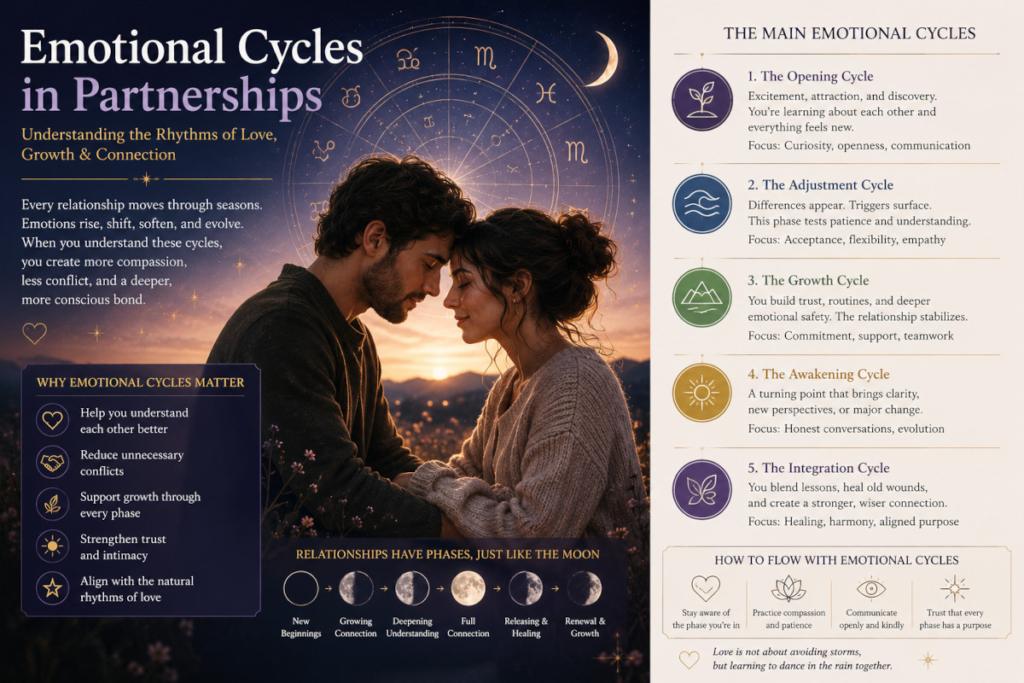
The lunar cycle moves from New Moon to Full Moon and back again. Symbolically, this reflects beginnings, growth, emotional fullness, release, and renewal.
In relationships, lunar phases can help partners understand why certain moments feel better for fresh starts, emotional conversations, reflection, forgiveness, or rest.
This does not mean couples must plan every interaction around the Moon. But lunar awareness can add useful timing wisdom, especially for sensitive conversations or emotional check-ins.
New Moon: Emotional Reset and Fresh Intentions
The New Moon often brings a quieter emotional tone. It is a time of reset, intention, and new beginnings. In relationships, this phase can support starting fresh after confusion, setting shared intentions, or gently opening a new chapter.
Partners may feel less emotionally dramatic during this phase, but also less clear about what is fully developing. The energy is new and still forming.
This can be a helpful time to ask simple questions: What do we want to create next? What emotional habit are we ready to begin? What kind of connection do we want to nurture this month?
The New Moon is not always best for forcing major answers. It is better for planting seeds and creating emotional space.
Waxing Moon: Building Connection
As the Moon grows from New to Full, emotional energy often builds. This waxing phase can support momentum, openness, planning, and relationship growth.
Partners may feel more willing to connect, take action, discuss plans, and invest energy into the relationship. This phase can be useful for date nights, meaningful conversations, shared goals, and emotional repair that requires effort.
However, as energy builds, pressure can also increase. Small issues may become more noticeable because the relationship is moving toward greater emotional visibility.
The waxing Moon asks partners to participate actively in the relationship. It is a time to build, not avoid.
First Quarter Moon: Tension and Adjustment
The First Quarter Moon can bring friction, decisions, and emotional challenge. In relationships, this phase may reveal where intentions need action and where unresolved issues require attention.
This does not mean the phase is bad. It can be productive if both partners are willing to work through tension honestly.
However, it may not be the easiest time for sensitive people or fragile conversations. If both partners are already stressed, this phase can make disagreements feel sharper.
The best use of this energy is constructive problem-solving. Instead of asking, “Why are we struggling?” ask, “What adjustment is needed now?”
Full Moon: Emotional Clarity and Intensity
The Full Moon often brings emotions to the surface. Feelings that were hidden, minimized, or delayed may become harder to ignore.
In partnerships, the Full Moon can reveal truths. It can bring emotional closeness, honest conversations, romantic intensity, or important realizations. But it can also heighten sensitivity, reactivity, and misunderstandings.
This phase can be powerful for emotional honesty, but it requires care. Partners may need to speak gently, listen carefully, and avoid turning heightened emotion into unnecessary conflict.
The Full Moon asks: What is ready to be seen?
Sometimes what is revealed is love. Sometimes it is resentment. Sometimes it is a need that has been waiting for attention. Whatever appears, the goal is awareness, not blame.
Waning Moon: Release, Reflection, and Repair
After the Full Moon, emotional energy begins to turn inward. The waning phase supports reflection, integration, forgiveness, and release.
In relationships, this can be a good time to process what was learned, let go of old arguments, soften defensiveness, and make space for renewal.
Partners may feel less socially or emotionally available during this phase. This does not always mean withdrawal from the relationship. It may simply mean the nervous system needs time to digest emotional experiences.
The waning Moon teaches that love also needs quiet. Not every emotional process has to be discussed immediately. Sometimes healing happens through rest, space, and gentle reconnection.
Planetary Transits and Temporary Emotional Shifts
Planetary transits can temporarily change the emotional atmosphere of a partnership. These periods may bring more sensitivity, passion, pressure, optimism, confusion, or seriousness.
Moon transits can shift emotional focus for a few days. Venus transits may bring affection, romance, harmony, or questions about values. Mars transits can increase desire and motivation, but may also heighten conflict. Saturn transits often bring responsibility, commitment, distance, or maturity lessons. Neptune transits may bring dreams, compassion, or confusion. Pluto transits can intensify emotional patterns and reveal deeper truths.
Transits do not force a relationship to succeed or fail. They simply describe the kind of emotional weather moving through the connection.
When partners understand this, they may take difficult periods less personally. Instead of assuming the relationship is broken, they can ask what the current season is asking them to learn.
Emotional Availability: When One Partner Is Open and the Other Is Not
One of the most common emotional cycle challenges in relationships is mismatched availability.
One partner may be ready to connect, talk, cuddle, plan, or share feelings. The other may feel tired, overstimulated, emotionally full, or in need of solitude. If this difference is not understood, both people may feel hurt.
The partner seeking connection may feel rejected. The partner needing space may feel pressured.
This is where emotional cycle awareness becomes practical. Instead of interpreting different needs as lack of love, partners can communicate more clearly.
For example, one person might say, “I care about you, but I need a quiet evening before I can talk deeply.” Another might say, “I understand you need space, but I would feel better if we choose a time to reconnect.”
The goal is not constant availability. The goal is trustworthy rhythm.
How to Communicate Emotional Cycles
Emotional cycles become much easier to manage when partners speak about them openly. The language does not need to be complicated. In fact, simple language often works best.
Instead of saying, “You are distant,” try saying, “I notice we feel less connected today. Do you need space, or would a small check-in help?”
Instead of saying, “You never want to talk,” try saying, “I would like to talk about something important. When would you have the emotional energy for that?”
Instead of saying, “You are too emotional,” try saying, “I want to understand what you are feeling, and I also want us to slow down so we do not hurt each other.”
This kind of communication turns emotional cycles into shared information instead of personal accusation.
Creating Relationship Rituals Around Emotional Cycles
Relationship rituals help partners stay connected even when emotional cycles differ. A ritual does not have to be dramatic. It simply needs to be consistent enough to create safety.
A weekly emotional check-in can help both people name what they are feeling before tension builds. A monthly reflection around the New Moon can help the couple set intentions. A Full Moon conversation can support emotional honesty if both partners feel ready. A quiet evening during the waning Moon can honor the need for rest and integration.
Rituals can also be practical. Partners might agree to pause difficult conversations when one person is overwhelmed, but always return to them later. They might plan alone time without treating it as rejection. They might create a shared calendar for stressful weeks, family obligations, or personal emotional patterns.
Healthy rituals create predictability without removing freedom.
Tracking Emotional Cycles Without Becoming Controlled by Them
Tracking emotional cycles can be helpful, but it should not become obsessive. The purpose is awareness, not control.
You can track simple patterns: when you feel open, when you need space, when you become sensitive, when conflict escalates, when affection feels easiest, and when you need more reassurance.
You may also notice lunar patterns. Perhaps Full Moons make you more emotionally expressive. Perhaps waning phases make you quieter. Perhaps certain transits coincide with relationship pressure or clarity.
But astrology should not become a rigid rulebook. Not every feeling needs a cosmic explanation. Sometimes people are tired, stressed, hungry, busy, or hurt for ordinary reasons.
The most balanced approach is to combine astrology with real-life awareness. Use the chart and cycles as a mirror, not a cage.
Emotional Cycles in Early Dating
In early dating, emotional cycles can feel exciting and confusing. Both people are still learning each other’s rhythms. A delayed reply, a quiet mood, or a sudden need for space may feel more dramatic because trust has not fully formed yet.
This stage benefits from gentle curiosity. Instead of assuming disinterest, notice patterns over time. Does the person communicate consistently? Do they return after needing space? Are they emotionally honest? Do their actions match their words?
Astrology can help reveal emotional style, but behavior still matters most.
Early dating is a good time to learn how someone handles closeness, distance, stress, and communication. If both people can speak about emotional needs without pressure, the connection has a stronger foundation.
Emotional Cycles in Long-Term Partnerships
In long-term relationships, emotional cycles become part of the couple’s shared rhythm. Partners may begin to recognize each other’s patterns before they are spoken.
One person may know that their partner needs quiet after a stressful day. Another may know that emotional reassurance is important during uncertain times. Over time, these small understandings create trust.
However, long-term partnerships can also fall into automatic patterns. One partner may always pursue while the other withdraws. One may always manage emotions while the other avoids them. One may always ask for connection while the other decides the timing.
Emotional cycle awareness helps couples refresh these patterns. It invites both people to ask whether the rhythm still feels mutual, kind, and balanced.
Emotional Cycles During Conflict
Conflict often becomes worse when it happens during a low-availability or high-sensitivity emotional phase. A conversation that could be manageable on another day may become overwhelming when one or both partners are already emotionally stretched.
This does not mean difficult conversations should always be delayed. Avoidance can damage trust. But timing and tone matter.
If one partner is too activated to listen, a pause may be healthier than pushing forward. If one partner needs clarity, it can help to choose a specific time to return to the topic. If both partners are highly emotional, grounding before discussion may prevent unnecessary harm.
Emotional cycles teach that resolution is not only about what is said. It is also about when and how it is said.
When Emotional Cycles Become an Excuse
Astrology should never be used to excuse harmful behavior. Emotional cycles can explain sensitivity, distance, or timing needs, but they do not justify cruelty, manipulation, disrespect, dishonesty, or repeated avoidance.
A person may need space, but they are still responsible for communicating respectfully. A person may feel emotionally intense, but they are still responsible for not hurting others. A person may be in a difficult transit, but they are still accountable for their choices.
Healthy emotional cycle awareness increases responsibility. It does not remove it.
If a relationship consistently feels unsafe, controlling, or emotionally damaging, astrology should not be used to rationalize staying. Real-world well-being matters more than any chart pattern.
Using Emotional Cycles for Greater Intimacy
When used wisely, emotional cycle awareness can deepen intimacy. Partners begin to understand not only what each person feels, but when and why those feelings tend to rise.
This creates compassion. The partner who needs space no longer seems cold. The partner who needs reassurance no longer seems needy. The partner who wants to talk no longer seems demanding. The partner who needs quiet no longer seems rejecting.
Instead, both people become more skilled at reading the emotional weather of the relationship.
Greater intimacy does not mean constant closeness. It means both partners trust that closeness can return after distance, repair can follow conflict, and emotional differences can be honored without fear.
Practical Ways to Work With Emotional Cycles
Start by learning your Moon sign and reflecting on whether its emotional style feels accurate for you. Then notice your real-life patterns. Astrology is most useful when it is tested through lived experience.
Track your emotional availability for a month. Notice when you feel connected, when you need solitude, when you feel sensitive, and when you are most ready for honest conversation.
Invite your partner into the process gently. You do not need to force astrology on someone who is not interested. You can simply speak in practical terms: “I am noticing I need more quiet after stressful days,” or “I think we talk better when we plan important conversations instead of starting them late at night.”
Use emotional cycles to create better timing, not to avoid responsibility. Plan connection during available phases. Allow space during reflective phases. Return to difficult topics when both people can listen.
The goal is not perfection. The goal is emotional cooperation.
Frequently Asked Questions
How do Moon signs affect emotional cycles in partnerships?
Moon signs describe a person’s baseline emotional style. Fire Moons often need expression and movement, earth Moons need stability and reliability, air Moons need communication and perspective, and water Moons need emotional depth and safety. In partnerships, different Moon signs can create different rhythms of connection, space, and emotional processing.
Can emotional cycles be tracked?
Yes. Emotional cycles can be tracked by observing mood, availability, sensitivity, relationship needs, lunar phases, and major transits. The most useful tracking is simple and reflective. It should help you understand patterns without making you feel controlled by them.
What should couples do when their emotional cycles conflict?
Couples should communicate needs clearly, avoid blame, and look for compromise timing. If one partner needs connection while the other needs space, it can help to agree on a specific time to reconnect. Both needs should be respected rather than treating one rhythm as more valid than the other.
Do lunar phases affect every relationship the same way?
No. Lunar phases create a general emotional rhythm, but each person responds differently based on their birth chart, life circumstances, stress level, and emotional habits. The same Full Moon may make one person expressive and another person overwhelmed.
Can emotional cycle awareness fix a relationship?
Emotional cycle awareness can improve understanding, timing, and communication, but it cannot fix a relationship by itself. A healthy partnership still requires respect, honesty, accountability, boundaries, and mutual effort.
Conclusion
Emotional cycles are part of every partnership. They shape when partners feel open, when they need space, when sensitivity rises, when conversations flow, and when emotional repair becomes possible.
Astrology offers a meaningful language for these rhythms through Moon signs, lunar phases, and planetary transits. The Moon shows emotional needs. Lunar phases show cycles of beginning, growth, fullness, release, and renewal. Transits show temporary emotional weather that can influence timing and awareness.
But the most important part of emotional cycle awareness is not prediction. It is compassion.
When partners understand that emotional rhythms naturally differ, they can stop turning every shift into a threat. They can communicate more clearly, choose better timing, and respect both closeness and space.
The strongest relationships are not always emotionally synchronized. They are built by people who learn how to return to each other with patience, honesty, and care.
Emotional cycles remind us that love is not static. It breathes, changes, retreats, returns, deepens, and renews. When partners learn to move with that rhythm, the relationship becomes more conscious, more flexible, and more emotionally alive.