Introduction
Relationships rarely unfold in a straight line. Attraction, timing, emotional readiness, communication, conflict, and personal history all shape the way people connect. Sometimes a relationship feels easy from the beginning. Sometimes a bond is challenging but deeply transformative. Sometimes the same pattern repeats with different people, leaving you wondering why love keeps following a familiar script.
Bayesian relationship analysis offers one way to understand these patterns more clearly. It combines probability-based thinking with relationship astrology, helping you look at compatibility, emotional timing, repeated behaviors, and growth potential through a more structured lens.
This approach does not claim that love can be reduced to numbers. It does not replace communication, maturity, emotional responsibility, or real-life experience. Instead, it adds another layer of insight. Traditional astrology describes meaning and symbolism. Bayesian analysis asks how patterns may update over time as new information appears.
In relationships, that can be powerful. Rather than asking, “Is this person my destiny?” Bayesian analysis encourages a more useful question: “What patterns are present, how strong are they, and what new evidence should change the way I understand this connection?”
What Is Bayesian Relationship Analysis?
Bayesian analysis is a probability-based method for updating beliefs when new evidence becomes available. In simple terms, it starts with what is already known, adds new data, and creates a more refined understanding.
Applied to relationships, this means you do not treat one chart aspect, one transit, one date, or one emotional reaction as the whole story. Instead, you combine multiple signals.
These signals may include natal chart placements, synastry aspects, composite chart themes, current transits, emotional cycles, relationship history, timing patterns, communication habits, and real-world behavior.
For example, traditional astrology might say that a Venus-Saturn contact can bring seriousness, caution, or commitment lessons in love. Bayesian thinking would add: How has this pattern appeared in your life before? What happens when similar transits occur? Does the relationship show consistent behavior that supports commitment, or does the pattern mainly create fear and distance?
The result is not a fixed prediction. It is an updated perspective.
The Core Idea: Probability, Not Fate
The most important part of Bayesian relationship analysis is that it works with probabilities, not certainties. It does not say, “This relationship will succeed,” or “This relationship will fail.” It says, “Based on the available patterns, this connection may have certain strengths, risks, or growth themes.”
This distinction matters because relationships are shaped by choice. Two people with difficult chart patterns can build something healthy if they communicate honestly, take responsibility, and grow together. Two people with beautiful compatibility indicators can still struggle if they avoid emotional work or treat each other poorly.
Probability is not destiny. It is guidance.
Bayesian analysis helps you stay flexible. When new behavior appears, your understanding should update. If someone consistently shows emotional maturity, that matters. If someone repeatedly ignores your needs, that matters too. The chart is only one layer of evidence.
How Bayesian Thinking Works in Relationship Astrology
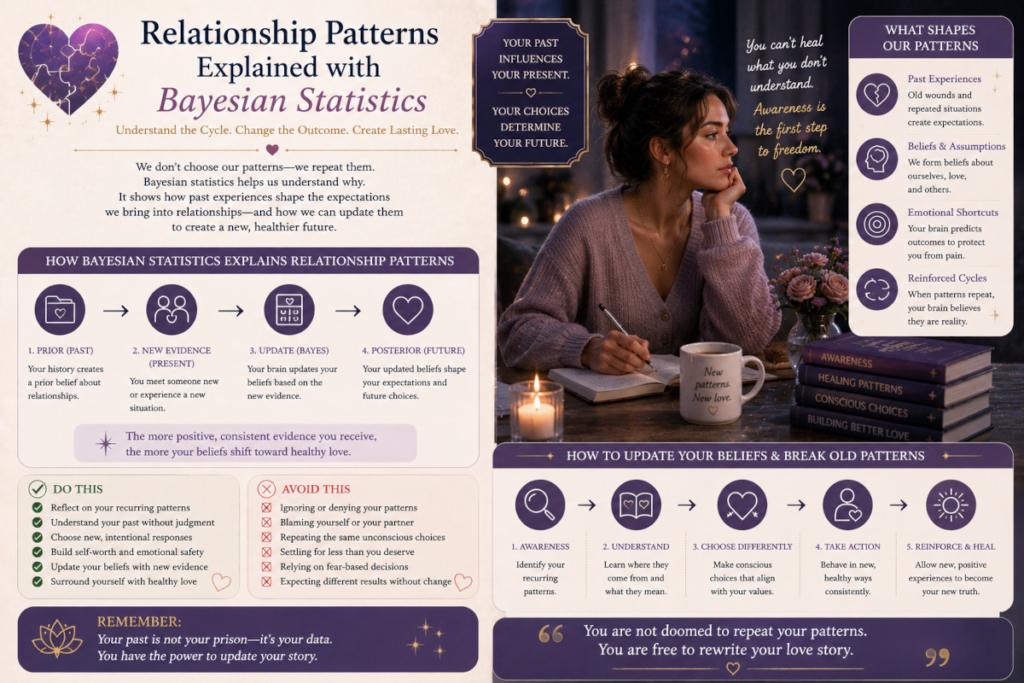
Bayesian relationship astrology can be understood through three simple steps.
Prior Understanding
The first step is prior understanding. This includes traditional astrological meanings, known compatibility principles, your past relationship experiences, and what you already know about your emotional needs.
For example, you may know that you are sensitive to inconsistent communication. You may also know that your Moon sign needs emotional reassurance, or that certain synastry patterns tend to activate your fear of rejection.
New Evidence
The second step is new evidence. This includes what is happening now: how a person communicates, how they handle conflict, what current transits are activating, how the relationship feels over time, and whether actions match words.
New evidence is essential because relationships are living systems. A promising chart does not matter if the relationship feels unsafe. A difficult chart does not mean failure if both people are aware and committed to growth.
Updated Insight
The third step is updated insight. This is the refined understanding that comes after combining old knowledge with new information.
You may realize that a relationship has high attraction but low emotional reliability. Or you may see that a connection has challenges, but those challenges are creating real growth rather than repeated harm. You may also discover that a pattern you once blamed on timing is actually connected to your own attachment responses.
Bayesian analysis is useful because it keeps your interpretation alive and responsive.
Compatibility vs. Growth Potential
One of the most helpful distinctions in Bayesian relationship analysis is the difference between compatibility and growth potential.
Compatibility describes how naturally two people fit together. It may include emotional rhythm, communication style, shared values, physical attraction, life goals, and day-to-day ease. High compatibility often feels comfortable, familiar, and supportive.
Growth potential describes how much a relationship can teach, stretch, challenge, or transform both people. High growth potential may feel intense, meaningful, and sometimes uncomfortable. It can bring important lessons, but it may also require more maturity and conscious effort.
A relationship can be highly compatible but not deeply transformative. Another relationship can be challenging but full of growth. The healthiest connections often include both: enough ease to feel safe and enough challenge to encourage evolution.
Bayesian analysis helps you avoid oversimplifying relationships into “good” or “bad.” Instead, it asks what kind of potential is present.
Using Natal Charts for Pattern Recognition
Your natal chart can reveal personal relationship tendencies. It may show what you need emotionally, how you express affection, what kind of partners attract you, how you respond to vulnerability, and where you may repeat old patterns.
Important placements for relationship pattern analysis include:
- the Moon for emotional needs and attachment responses;
- Venus for love language, attraction, values, and self-worth;
- Mars for desire, conflict, and pursuit style;
- Mercury for communication patterns;
- Saturn for commitment, fear, boundaries, and long-term lessons;
- Chiron for wounds and healing themes;
- the 7th house for partnership dynamics;
- the 8th house for intimacy, trust, and emotional merging.
Bayesian thinking adds a practical question: How often do these themes appear in your actual relationship history?
If your chart suggests a need for emotional consistency, and your past relationships often became painful when consistency was missing, that pattern becomes important evidence. If your chart shows fear around vulnerability, and you tend to withdraw when love becomes serious, that pattern also deserves attention.
Synastry and Relationship Probability
Synastry compares two birth charts and shows how two people activate each other. In Bayesian relationship analysis, synastry is not treated as a final verdict. It becomes one part of a larger probability map.
Some synastry aspects may suggest emotional ease, attraction, shared values, mental connection, or long-term commitment potential. Other aspects may show tension, timing issues, communication differences, power struggles, or emotional triggers.
But the key question is not only what the aspects mean. The key question is how those aspects behave in real life.
A challenging Mars aspect may create conflict, but it may also create passion and motivation if both people communicate well. A Saturn contact may feel heavy, but it can also support loyalty and endurance when handled maturely. A Venus aspect may bring attraction, but attraction alone does not guarantee emotional safety.
Bayesian analysis encourages you to compare chart indicators with lived evidence.
Composite Charts and the Relationship as a System
A composite chart represents the relationship itself as a shared energetic system. It can show the identity, emotional climate, communication style, love language, conflict pattern, and long-term lessons of the connection.
In Bayesian relationship analysis, the composite chart helps answer a different question from synastry. Synastry asks how two people affect each other. The composite chart asks what they become together.
This matters because two people may have strong attraction individually, but the relationship itself may feel unstable or unclear. Another pair may not seem dramatic in synastry, yet their composite chart may show strong partnership potential, emotional steadiness, or shared purpose.
Bayesian thinking treats the composite chart as another data layer. It asks whether the relationship’s shared pattern is supported by real behavior, timing, and mutual effort.
Emotional Cycles and Timing Patterns
Relationships are strongly affected by timing. Certain periods may support closeness, repair, and clarity. Other periods may bring confusion, distance, conflict, or emotional intensity.
Bayesian relationship analysis can help identify recurring emotional cycles. For example, you may notice that relationship conflicts tend to rise during certain lunar phases, Mercury retrograde periods, Venus transits, Saturn activations, or stressful personal cycles.
This does not mean the planets cause every argument. It means timing patterns can help you become more aware.
If you know that certain periods make communication more sensitive, you can slow down before reacting. If you know that a particular transit tends to bring relationship review, you can use it for reflection instead of panic. If you know that your emotional availability changes with stress or lunar cycles, you can communicate that more clearly.
Timing awareness works best when it creates patience, not fear.
Relationship History as Data
Your own relationship history is one of the most important sources of evidence. Patterns become clearer when you look across multiple experiences rather than focusing only on one relationship.
You may ask:
- What type of person do I repeatedly choose?
- When do my relationships usually begin or end?
- What conflicts repeat across different partners?
- What makes me feel safe, and what makes me withdraw?
- Do I mistake intensity for compatibility?
- Do I choose familiar dynamics even when they hurt?
- Which relationships helped me grow in a healthy way?
This kind of reflection turns personal history into insight. It helps you see whether a current relationship is truly different or simply another version of an old pattern.
Bayesian analysis becomes more useful when it includes both astrology and honest self-observation.
Practical Uses for New Relationships
In new relationships, Bayesian thinking can help you move with curiosity instead of fantasy. Early attraction can be exciting, but it can also make people ignore important evidence.
A probability-based approach encourages you to observe patterns over time. Does communication remain consistent after the first spark? Does the person respect boundaries? Do they show emotional maturity during disagreement? Do your charts suggest strong attraction but also possible timing challenges? Are those challenges already appearing?
This does not mean dating should become cold or analytical. It means you stay awake inside the experience.
For new relationships, useful questions include:
- What evidence supports trust?
- What evidence suggests caution?
- Am I responding to this person or to an old pattern?
- Does the connection feel stable when the excitement slows down?
- Are we compatible in daily life, not only in chemistry?
Bayesian relationship analysis helps you let attraction be important without making it the only evidence.
Practical Uses for Established Relationships
In established relationships, Bayesian analysis can help partners understand repeated patterns. Instead of arguing about the same issue again and again, couples can study the pattern behind the argument.
For example, you may notice that conflicts happen more often during stressful work periods, after family interactions, during certain transits, or when one partner feels emotionally ignored. Once the pattern is visible, it becomes easier to change.
Established relationships can use Bayesian thinking to improve:
- communication timing;
- conflict prevention;
- emotional check-ins;
- repair after difficult conversations;
- shared decision-making;
- awareness of repeating triggers;
- long-term growth planning.
The purpose is not to prove who is right. The purpose is to understand what keeps repeating and what new evidence suggests a better path.
Practical Uses During Relationship Transitions
Relationship transitions can include becoming exclusive, moving in together, getting engaged, ending a relationship, reconnecting after distance, or redefining the relationship.
These moments carry emotional weight. Bayesian relationship analysis can help you slow down and consider timing, patterns, and evidence before making major decisions.
Ask yourself whether the transition is supported by consistent behavior, shared values, emotional readiness, and healthy timing. A beautiful transit may support a conversation, but it should not override real incompatibility. A difficult transit may bring stress, but it does not automatically mean the relationship is wrong.
Good decisions combine inner knowing, astrology, evidence, and honest communication.
Traditional Astrology and Bayesian Analysis Together
Traditional astrology and Bayesian analysis do not need to compete. They answer different parts of the same question.
Traditional astrology offers symbolism, meaning, archetypes, and emotional language. It helps you understand why a pattern feels important. Bayesian analysis adds structure, pattern tracking, probability, and updated interpretation. It helps you ask how often a pattern appears and whether new evidence changes the picture.
Together, they create a more complete approach.
Traditional astrology may say, “This relationship has a strong Saturn theme, so commitment, timing, responsibility, and maturity are important.” Bayesian analysis may ask, “When Saturn themes appear in your relationships, what usually happens? Does this connection show healthy responsibility or emotional heaviness? Has the pattern improved over time?”
This combination keeps astrology meaningful but grounded.
Daily Relationship Pattern Awareness
You do not need complex tools to begin using Bayesian thinking in relationships. You can start with simple daily awareness.
Each day, notice your emotional state, relationship interactions, communication quality, and relevant astrological timing. Over time, patterns may appear.
You might track:
- mood and emotional availability;
- important conversations;
- conflicts or misunderstandings;
- moments of closeness;
- lunar phase or major transits;
- personal triggers;
- how quickly repair happens.
The goal is not to obsess over every detail. The goal is to notice what repeats.
Weekly and Monthly Relationship Reviews
A weekly or monthly review can help turn scattered experiences into clear insight. This is especially useful for people who feel confused by emotional ups and downs.
During a weekly review, ask what worked, what felt difficult, what conversations mattered, and whether any pattern appeared more than once.
During a monthly review, look at bigger cycles. Did a certain transit coincide with emotional clarity? Did a repeated conflict return? Did a specific kind of partner or behavior trigger old fears? Did your choices support the relationship you actually want?
This reflection helps you make more conscious decisions instead of repeating patterns automatically.
Privacy and Data Ethics in Relationship Analysis
Because Bayesian relationship analysis can involve personal data, privacy matters. Birth data, relationship history, emotional patterns, and compatibility insights can be sensitive. They should be handled carefully.
If you use digital tools, choose platforms that clearly explain how data is stored, protected, and deleted. Be thoughtful about entering another person’s birth information, especially if they have not consented to relationship analysis.
Ethical relationship analysis should respect both people. It should not turn someone’s chart into a surveillance tool or a way to control them.
Use data for self-awareness, not manipulation. Use astrology to understand, not to invade privacy or remove someone’s freedom.
Limitations of Bayesian Relationship Analysis
Bayesian analysis can be useful, but it has limits. It cannot predict love with certainty. It cannot guarantee compatibility. It cannot replace emotional intelligence, communication, therapy, or real-world behavior.
It also cannot justify staying in a harmful relationship. If a relationship involves control, fear, manipulation, repeated disrespect, or emotional harm, probability-based insights should never be used to explain it away.
Important limitations include:
- probabilities are not certainties;
- data can be incomplete or biased;
- people change over time;
- relationships depend on choices, not only patterns;
- astrological interpretation requires context;
- real-world safety and respect matter more than any chart.
The best use of Bayesian analysis is supportive, not controlling.
How to Use Bayesian Insights Ethically
Ethical use begins with humility. A probability is not a verdict. A chart pattern is not a sentence. A transit is not an excuse. A compatibility score is not a replacement for getting to know someone.
Use Bayesian relationship insights to ask better questions, not to make final judgments too quickly.
Healthy use includes:
- respecting free will;
- communicating instead of assuming;
- using insights for self-awareness;
- avoiding deterministic language;
- protecting personal and partner data;
- balancing astrology with lived experience;
- seeking professional support for serious relationship issues.
Relationship analysis should help people become more responsible, not more fearful.
When Bayesian Analysis Can Be Most Helpful
Bayesian relationship analysis is especially useful when you are trying to understand repeated patterns. It can help if you keep choosing similar partners, if your relationships often end during similar phases, if certain conflicts repeat, or if you struggle to tell the difference between chemistry and compatibility.
It can also support people who want to make relationship decisions more consciously. Instead of relying only on hope, fear, or attraction, you can consider patterns, evidence, timing, and values together.
This approach is helpful when it brings clarity. It becomes unhelpful when it creates anxiety, overthinking, or a desire to control every outcome.
Love needs awareness, but it also needs presence.
How to Begin Your Own Relationship Pattern Analysis
You can begin with a simple process.
- Gather accurate birth data if you use astrology.
- Write down key dates from relationship history.
- Notice repeating emotional themes.
- Compare relationship events with major transits or lunar phases.
- Reflect on synastry and composite chart themes.
- Track real-world behavior, not only feelings.
- Update your understanding as new evidence appears.
- Use insights to make kinder, clearer choices.
You do not need to become a mathematician to use Bayesian thinking. The deeper practice is simple: stay open to new evidence. Let your understanding evolve.
Frequently Asked Questions
What is Bayesian relationship analysis?
Bayesian relationship analysis is a probability-based way of understanding relationship patterns. It combines prior knowledge, such as astrological principles or personal history, with new evidence, such as current behavior, transits, timing, and relationship events, to create an updated view of a connection.
Can Bayesian analysis predict relationship success?
It can suggest probabilities, patterns, strengths, and risks, but it cannot predict success with certainty. Relationships depend on free will, communication, maturity, values, timing, emotional safety, and real-world choices.
How is Bayesian analysis different from traditional astrology?
Traditional astrology focuses on symbolic meaning and interpretation. Bayesian analysis adds pattern tracking and probability-based thinking. Traditional astrology may explain the meaning of a pattern, while Bayesian analysis asks how strongly that pattern appears and how new evidence changes the interpretation.
Can this approach help with dating?
Yes, it can help you slow down, notice compatibility patterns, observe emotional consistency, and avoid confusing chemistry with long-term alignment. However, it should be used as one tool, not as the only basis for choosing a partner.
Is relationship data private?
Relationship data can be very personal, so privacy matters. If you use digital tools, check how your birth data, relationship history, and compatibility insights are stored and protected. Ethical analysis should respect consent, privacy, and personal boundaries.
Conclusion
Relationship patterns become easier to understand when astrology, probability, and real-life behavior are considered together. Bayesian relationship analysis offers a flexible way to study compatibility, emotional cycles, timing, growth potential, and repeated relationship themes.
Its greatest value is not prediction. Its value is awareness.
By combining traditional astrological insight with updated evidence, you can make more conscious choices in love. You can notice when a pattern is repeating, when a relationship is asking for growth, when timing matters, and when new behavior changes the story.
Still, no chart, formula, score, or probability can replace respect, communication, emotional safety, and mutual effort. Love is not only a pattern to analyze. It is a relationship to live.
Used wisely, Bayesian relationship analysis can help you understand the map. But your choices, honesty, and care determine the path.