Introduction
Relationship sabotage often begins quietly. A connection starts to feel real, and suddenly old fears rise to the surface. You may pull away, create conflict, test the other person, choose someone unavailable, or convince yourself that the relationship will fail before it has a chance to grow.
These patterns can feel confusing because part of you may deeply want love, closeness, trust, and stability. Another part may feel unsafe when those things actually arrive.
Relationship sabotage is not a sign that someone is broken or incapable of love. In many cases, it is a protection mechanism. The mind and heart may try to avoid vulnerability by creating distance before intimacy becomes too real. The problem is that the same pattern that once protected you can later block the very connection you want.
Astrology can offer a helpful language for understanding these cycles. Saturn may show fear, emotional walls, and commitment lessons. Chiron may reveal wounds around love and self-worth. The Moon may show emotional needs and attachment patterns. Venus may describe how someone gives and receives love. Synastry can reveal why certain partners activate old fears more strongly than others.
Astrology does not replace therapy, self-work, communication, or real-life accountability. But it can help you understand your patterns with more compassion. Healing begins when you stop asking, “Why do I ruin everything?” and start asking, “What part of me is trying to stay safe, and how can I teach it a healthier way?”
What Is Relationship Sabotage?
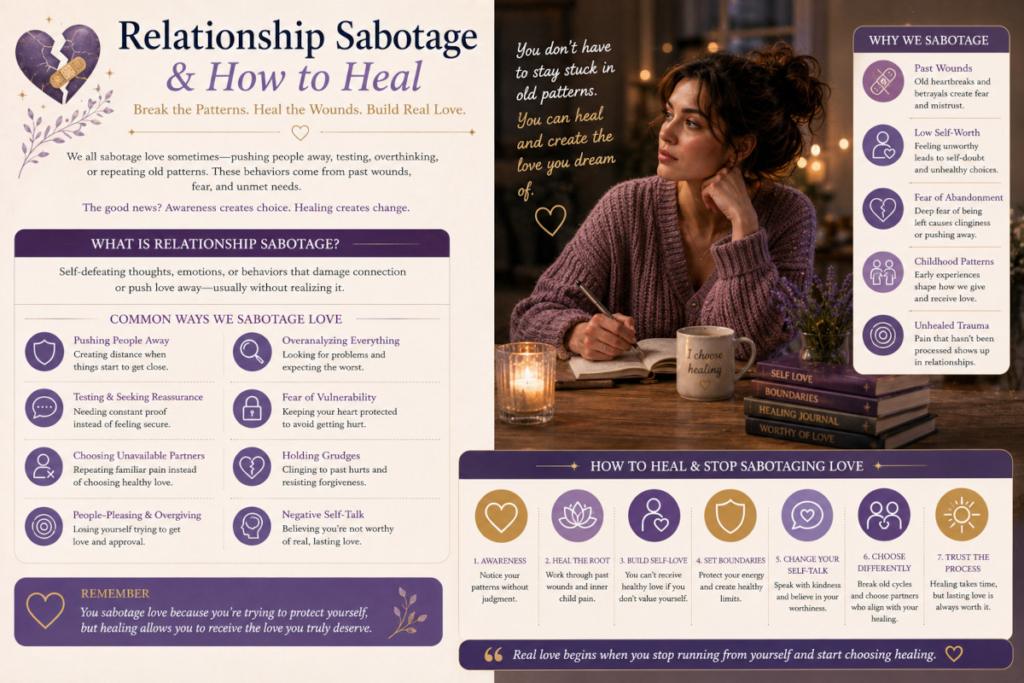
Relationship sabotage is a pattern of thoughts, behaviors, or reactions that weaken a connection even when the relationship may have real potential. These behaviors are often unconscious. A person may not intentionally want to damage the relationship, but they may still act in ways that create distance, confusion, instability, or conflict.
Sabotage can happen at any stage of a relationship. It may appear during early dating, when someone becomes interested but then suddenly loses trust. It may appear when a relationship becomes more serious, when emotional vulnerability increases, or when commitment becomes possible.
Some people sabotage by withdrawing. Others sabotage by clinging. Some create arguments. Others choose partners who cannot fully show up. Some keep emotional walls so high that love cannot enter. Others give too much and then feel resentful when the relationship becomes unbalanced.
At the root of many sabotage patterns is fear. Fear of being abandoned. Fear of being controlled. Fear of being disappointed. Fear of being seen clearly. Fear of depending on someone. Fear that love will disappear if you relax into it.
Healing does not mean forcing yourself to trust blindly. It means learning the difference between real danger and old fear.
Why People Sabotage Relationships
Most sabotage patterns are not random. They usually develop as emotional survival strategies. A person may have learned that closeness leads to pain, that love is unreliable, that needs are unsafe, or that vulnerability creates rejection.
When a new relationship begins to feel meaningful, the nervous system may remember old experiences. Even if the current person is different, the body and emotions may react as if the past is happening again.
Common reasons for relationship sabotage include:
- fear of intimacy and emotional exposure;
- fear of abandonment, rejection, or betrayal;
- low self-worth or feeling undeserving of healthy love;
- past heartbreak or unresolved relationship wounds;
- childhood patterns around love, safety, or emotional availability;
- confusion between healthy boundaries and emotional walls;
- choosing familiar pain over unfamiliar peace.
The painful truth is that healthy love can feel unfamiliar if chaos, distance, inconsistency, or emotional struggle became normal in the past. A calm relationship may feel suspicious. A kind partner may feel “too good to be true.” Stability may feel boring or unsafe simply because it is new.
Healing begins by recognizing that discomfort does not always mean danger. Sometimes discomfort means you are entering a new emotional pattern.
Common Relationship Sabotage Patterns
Relationship sabotage can appear in many forms. Some patterns are obvious, while others look reasonable on the surface. The key is repetition. If similar problems happen again and again across different relationships, there may be a deeper pattern asking for attention.
The Push-Pull Pattern
The push-pull pattern happens when a person wants closeness but becomes afraid when closeness arrives. They may pursue someone intensely, then withdraw once the relationship becomes more real. They may send warm signals one day and distant signals the next.
This pattern can confuse both people. The person doing the push-pull may feel genuinely torn. They want love, but intimacy activates fear. The partner may feel unsure, rejected, or emotionally exhausted.
Healing this pattern requires learning to stay present through closeness without immediately creating distance.
The Incompatible Partner Pattern
Some people repeatedly choose partners who cannot meet their needs. They may be attracted to unavailable people, emotionally distant people, chaotic people, or people who clearly want different things.
This can be a subtle form of sabotage because it protects against real intimacy. If someone is unavailable, the relationship can never fully succeed. The person can then experience longing without facing the vulnerability of a truly available partnership.
Healing requires asking not only, “Do I want this person?” but also, “Is this person actually capable of building the kind of relationship I need?”
The Conflict Creation Pattern
Conflict creation happens when a person starts arguments, escalates small issues, tests loyalty, or turns uncertainty into drama. Sometimes the conflict is a way to check whether the other person will stay. Sometimes it is a way to create distance before vulnerability becomes too intense.
This pattern often comes from fear. The person may not believe love is stable unless it is constantly proven. But repeated testing can damage trust.
Healing means learning to ask directly for reassurance, clarity, or repair instead of creating crisis to receive it.
The Early Exit Pattern
The early exit pattern appears when someone leaves before a relationship becomes serious. They may suddenly focus on minor flaws, feel trapped, lose interest, or decide the connection is not right just when commitment becomes possible.
Sometimes leaving is healthy. Not every relationship should continue. But if the urge to leave appears whenever intimacy deepens, the pattern may be about fear rather than truth.
Healing means slowing down before making final decisions and asking, “Am I responding to real incompatibility, or am I trying to escape vulnerability?”
The Perfection Pattern
The perfection pattern happens when someone believes a relationship must feel ideal to be safe. They may search for the perfect partner, perfect timing, perfect chemistry, or perfect emotional certainty.
When normal imperfections appear, they may use them as evidence that the relationship is wrong. This can prevent them from experiencing real love, because real relationships always involve difference, adjustment, and growth.
Healing requires realistic expectations. A healthy relationship is not flawless. It is a connection where both people can communicate, repair, and grow.
Astrological Roots of Relationship Sabotage
Astrology can help identify symbolic patterns behind relationship sabotage. A birth chart does not doom anyone to repeat painful cycles, but it can show where fear, wounds, and growth lessons may appear.
The most useful placements to explore are Saturn, Chiron, the Moon, Venus, Mars, the South Node, the 7th house, and the 8th house. Synastry can also show how another person may activate these sensitive areas.
Saturn: Fear, Walls, and Commitment Lessons
Saturn represents responsibility, time, discipline, fear, boundaries, maturity, and life lessons. In relationships, Saturn can show where a person is cautious, guarded, or afraid of disappointment.
Challenging Saturn contacts with Venus, the Moon, the Descendant, or the 7th house may point to fears around love, emotional availability, commitment, or worthiness. A person may deeply want stability but also fear the pressure that comes with it.
Saturn sabotage often sounds like:
- “I am not ready.”
- “This will probably fail.”
- “I cannot depend on anyone.”
- “Love always comes with responsibility I cannot handle.”
- “I have to protect myself before I get disappointed.”
Saturn healing is not about removing boundaries. It is about building healthy boundaries instead of walls. Saturn becomes supportive when it teaches patience, accountability, emotional maturity, and realistic commitment.
Chiron: Love Wounds and the Fear of Reopening Pain
Chiron represents wounds, sensitivity, healing, and wisdom gained through pain. In relationship astrology, Chiron can show where old hurt becomes activated by love.
Chiron connected to Venus may point to wounds around being valued, chosen, or loved. Chiron connected to the Moon may show emotional wounds around safety, nurturing, or belonging. Chiron in the 7th or 8th house may indicate deep sensitivity around partnership, trust, or vulnerability.
When Chiron is triggered, a person may react strongly to situations that seem small from the outside. A delayed message, a change in tone, a disagreement, or a moment of distance can touch an old wound.
Chiron healing begins with compassion. The wound is real, but it does not have to control every relationship. Over time, Chiron can become a source of wisdom. The person learns to recognize pain without letting pain make all the decisions.
The Moon: Emotional Needs and Attachment Patterns
The Moon shows emotional needs, instincts, comfort patterns, and attachment responses. It reveals what someone needs to feel safe and how they react when that safety feels threatened.
A person with a sensitive Moon may sabotage when they feel emotionally uncertain. A guarded Moon may withdraw when vulnerability increases. A restless Moon may create change when stability feels unfamiliar. A Moon under pressure in the birth chart may show difficulty trusting emotional consistency.
The Moon is important because sabotage often happens before logic can intervene. A person may know intellectually that the relationship is safe, but emotionally they may still feel threatened.
Moon healing involves learning your emotional needs and communicating them clearly. Instead of expecting a partner to guess, you can say what helps you feel secure, connected, and respected.
Venus: Self-Worth, Values, and Receiving Love
Venus shows how a person gives love, receives love, expresses affection, and defines value. It also connects to self-worth.
When Venus is wounded or under pressure, a person may struggle to believe they deserve healthy love. They may overgive to earn affection, accept less than they need, push away kindness, or become suspicious when love is easy.
Venus sabotage may appear as choosing people who do not value you, trying to become what someone else wants, or rejecting affection because receiving feels uncomfortable.
Venus healing asks you to build a relationship with your own worth. You do not have to perform, prove, rescue, or perfect yourself to be lovable. You are allowed to receive love without immediately questioning why it is there.
The South Node: Familiar Patterns That No Longer Help
The South Node represents old patterns, comfort zones, and familiar emotional habits. In relationship work, it can show dynamics that feel known even when they are not healthy.
South Node patterns can feel magnetic because they are familiar. You may repeat the same type of relationship, the same role, or the same emotional script. Even if the outcome hurts, the pattern may feel safer than the unknown.
South Node sabotage often sounds like:
- “This always happens to me.”
- “I keep choosing the same type of person.”
- “I know this hurts, but it feels familiar.”
- “I do not know who I am without this pattern.”
Healing means moving toward the North Node: the growth path. This often requires choosing unfamiliar but healthier behaviors.
Synastry: Why Certain People Trigger Sabotage
Synastry compares two birth charts and shows how people activate each other. Some connections feel easy and supportive. Others touch deep emotional material.
A partner’s planets may activate your Saturn, Chiron, Moon, Venus, 7th house, 8th house, or South Node. This can create strong attraction, but also strong triggers. You may feel drawn to someone and afraid of them at the same time, not because they are unsafe, but because they awaken old patterns.
Synastry can help you understand why a certain relationship brings up fear, longing, jealousy, control, withdrawal, or self-doubt. But it should not be used to blame the other person or excuse harmful behavior.
The best use of synastry is awareness. It can show where both people need more patience, communication, and emotional responsibility.
Attachment Styles and Sabotage
Attachment style describes how a person tends to respond to closeness, distance, safety, and uncertainty in relationships. Astrology can reflect attachment themes, but attachment is also shaped by real life, family patterns, past experiences, and healing work.
Anxious Attachment Sabotage
Anxious sabotage often appears as fear of abandonment. A person may seek frequent reassurance, interpret distance as rejection, become highly sensitive to changes in tone, or create conflict to test whether the partner will stay.
The healing path involves building inner security, communicating needs directly, and learning that a partner’s temporary distance does not always mean love is disappearing.
Avoidant Attachment Sabotage
Avoidant sabotage often appears as fear of dependence or loss of freedom. A person may withdraw, intellectualize emotions, focus on flaws, delay commitment, or end relationships when intimacy increases.
The healing path involves practicing safe vulnerability, staying present through closeness, and learning that intimacy does not have to mean losing independence.
Disorganized Attachment Sabotage
Disorganized sabotage may include both anxious and avoidant patterns. A person may want closeness intensely, then become afraid and push it away. This can create confusion, instability, and emotional chaos.
The healing path often requires steady support, self-awareness, nervous system regulation, and professional guidance. The goal is to build a sense of safety that does not depend on constant control or escape.
Relationship Sabotage vs. Healthy Boundaries
One of the most important parts of healing is learning the difference between sabotage and boundaries. They can look similar from the outside because both may involve saying no, creating space, or ending a situation. But the inner motivation is different.
A healthy boundary protects your well-being and is usually connected to values, needs, or respect. It can be communicated clearly. It does not require punishment, testing, or emotional confusion.
Sabotage is usually driven by fear, avoidance, or old pain. It often creates distance without explanation, starts unnecessary conflict, or ends connection before honest communication can happen.
Healthy boundaries say: “This is what I need to stay emotionally well.”
Sabotage says: “I need to escape before I can be hurt.”
Boundaries support love. Sabotage protects against love.
How to Recognize Your Sabotage Pattern
Recognition is the first step toward healing. You cannot change a pattern that remains invisible. Instead of judging yourself, approach your relationship history with curiosity.
Ask yourself:
- What usually happens when a relationship becomes serious?
- Do I choose emotionally available people?
- When do I pull away, test, criticize, or create distance?
- What feelings appear right before I sabotage?
- What am I afraid will happen if I stay open?
- Do I confuse calm love with lack of chemistry?
- Do I feel safer longing for love than receiving it?
These questions are not meant to create shame. They are meant to reveal the moment where choice becomes possible.
Journaling for Pattern Awareness
Journaling can help you observe relationship patterns without being overwhelmed by them. It gives the emotional mind a place to speak and the reflective mind a chance to notice repetition.
Helpful journal prompts include:
- When did I first learn that love was unsafe?
- What kind of partner do I repeatedly choose?
- What do I do when someone becomes emotionally available?
- What does my body feel when intimacy increases?
- What would I do differently if I believed I deserved healthy love?
- What boundary do I need, and what wall am I ready to lower?
If journaling brings up painful memories or intense emotional reactions, it may help to work with a therapist or trusted mental health professional. Deep healing does not have to be done alone.
The Healing Process: Awareness, Understanding, Practice
Healing relationship sabotage is not a single decision. It is a process. Most people do not stop sabotaging simply because they understand the pattern once. Healing requires repeated moments of awareness and new choices.
The Awareness Phase
The awareness phase begins when you notice the pattern while it is happening. You may feel the urge to withdraw, argue, test, overgive, disappear, or choose someone unavailable. Instead of acting automatically, you pause.
In that pause, you can ask: “Is this my present truth, or is this an old protection pattern?”
This phase requires honesty without shame. The goal is not to blame yourself. The goal is to see clearly.
The Understanding Phase
The understanding phase explores the roots of the pattern. This may include attachment style, childhood experiences, past relationships, self-worth wounds, family dynamics, or repeated astrological themes.
Understanding does not excuse hurtful behavior, but it explains why the pattern exists. When you understand the fear beneath the behavior, you can begin to respond to the fear directly instead of letting it control the relationship.
The Practice Phase
The practice phase is where healing becomes real. This is where you choose a new behavior even when the old one feels easier.
You may communicate a need instead of starting a fight. You may stay present instead of disappearing. You may choose an available partner instead of chasing an unavailable one. You may receive kindness without immediately questioning it. You may set a boundary calmly instead of creating chaos.
These choices may feel uncomfortable at first. That does not mean they are wrong. New patterns often feel unfamiliar before they feel safe.
Specific Sabotage Patterns and How to Heal Them
The “Too Good to Be True” Pattern
This pattern appears when a relationship feels healthy, kind, or promising, but instead of relaxing, you become suspicious. You may wait for something to go wrong, search for hidden problems, or create distance before disappointment can happen.
The healing approach is to practice receiving goodness slowly. Remind yourself that calm does not always mean danger. You can stay present and observe without destroying the connection to feel in control.
The “I Need Space” Pattern
Needing space can be healthy. But if space becomes a way to avoid every vulnerable conversation, it may become sabotage. This pattern often appears when someone withdraws whenever intimacy deepens.
The healing approach is to communicate space clearly. Instead of disappearing, say what you need and when you can reconnect. Space becomes healthy when it protects regulation, not when it avoids responsibility.
The “Testing Love” Pattern
Testing love happens when someone creates situations to see whether the partner will prove loyalty. They may become distant, start conflict, act jealous, or withhold affection to see what the other person does.
The healing approach is direct communication. Ask for reassurance instead of creating a test. A loving partner should not have to pass hidden exams to stay close to you.
The “Overgiving” Pattern
Overgiving can look loving, but it can also become sabotage when it creates imbalance. A person may give too much to earn love, avoid abandonment, or feel needed. Over time, they may become resentful or exhausted.
The healing approach is balanced giving. Ask whether support is mutual. Practice receiving. Notice whether you are helping from love or from fear.
The “Unavailable Partner” Pattern
This pattern appears when someone repeatedly becomes attached to people who cannot fully commit, communicate, or show up. The longing may feel intense, but the relationship remains out of reach.
The healing approach is choosing availability as a real standard. Chemistry matters, but consistency matters too. Love should not require chasing someone who is not emotionally present.
Using Astrology for Healing Without Blame
Astrology works best when it increases responsibility and compassion. It should not be used to say, “I sabotage because of my chart, so I cannot change.” It should also not be used to blame a partner for activating your wounds.
A chart shows patterns, not prison bars. Saturn can become maturity. Chiron can become wisdom. Venus can become self-worth. The Moon can become emotional awareness. The South Node can become a doorway toward the North Node’s growth.
The most healing question is not, “Which placement caused this?” The better question is, “What is this pattern asking me to learn?”
How Therapy and Self-Work Support Healing
Astrology can help you understand relationship patterns, but deep sabotage healing often benefits from therapy, coaching, support groups, or other forms of guided self-work. This is especially true when patterns are connected to trauma, attachment wounds, or repeated emotional pain.
A therapist can help you identify root causes, regulate emotional reactions, build self-worth, practice communication, and develop healthier relationship skills. Professional support can also help you understand whether a relationship pattern is truly sabotage or whether a situation is genuinely unhealthy.
Self-work matters too. Reading, journaling, mindfulness, emotional regulation, honest conversations, and supportive friendships can all help you practice new ways of relating.
Healing is not only insight. It is repeated care.
Practical Steps to Stop Sabotaging Love
When you feel the urge to sabotage, slow down. The urge may feel urgent, but you do not have to obey it immediately.
- Pause before reacting.
- Name the fear beneath the impulse.
- Ask whether the current situation is truly unsafe or simply unfamiliar.
- Communicate a need directly.
- Choose a boundary instead of a wall.
- Let healthy love feel uncomfortable without running from it.
- Seek support when the pattern feels too strong to manage alone.
- Celebrate small moments when you choose differently.
Healing is built through small choices. Every pause matters. Every honest conversation matters. Every time you stay present with care, you teach yourself that love can be safer than the past taught you.
When Leaving Is Not Sabotage
It is important to remember that not every ending is sabotage. Sometimes leaving is healthy. Sometimes distance is necessary. Sometimes your intuition is warning you that a relationship is not respectful, balanced, or emotionally safe.
Sabotage is usually automatic, fear-based, and repetitive. A healthy decision is usually grounded in values, clarity, and self-respect.
If a relationship includes manipulation, disrespect, control, repeated dishonesty, or emotional harm, leaving may be a boundary, not sabotage. Healing does not mean staying in every relationship to prove you are not afraid. Healing means learning to tell the difference between fear of intimacy and real incompatibility.
Your well-being matters. A relationship should not require you to abandon yourself.
Healing and Relationship Readiness
As sabotage patterns heal, relationship readiness begins to grow. You may become more able to choose compatible partners, communicate honestly, receive affection, set boundaries, and stay present through vulnerability.
You may also become more patient with yourself. Healing does not mean never being triggered. It means recognizing triggers sooner and responding with more awareness.
Relationship readiness is not perfection. It is the willingness to keep learning. It is the ability to say, “This is hard for me, but I want to handle it differently.”
When self-protection becomes self-awareness, love has more room to grow.
Frequently Asked Questions
What are common relationship sabotage patterns?
Common patterns include withdrawing when intimacy increases, choosing emotionally unavailable partners, creating unnecessary conflict, testing a partner’s loyalty, overgiving to earn love, leaving before commitment, or focusing on small flaws when the relationship becomes serious.
Can astrology explain why I sabotage relationships?
Astrology can offer symbolic insight into relationship fears, emotional wounds, attachment patterns, and repeated dynamics. Saturn, Chiron, Venus, the Moon, the South Node, and synastry can be especially helpful. However, astrology should be combined with self-awareness, communication, and therapeutic support when needed.
Is relationship sabotage the same as having boundaries?
No. Boundaries are based on values, needs, and well-being. They can be communicated clearly and respectfully. Sabotage is usually based on fear, avoidance, or old pain. Boundaries protect healthy connection, while sabotage often creates unnecessary distance or conflict.
How do I know if I am sabotaging or if the relationship is wrong?
Look for repetition and motivation. If you repeatedly want to leave or create conflict when closeness increases, fear may be involved. If the relationship consistently lacks respect, honesty, safety, or shared values, the issue may be real incompatibility. Support from a therapist can help you understand the difference more clearly.
How can I begin healing relationship sabotage?
Start by recognizing your pattern without shame. Track your triggers, explore the fear beneath the behavior, communicate needs directly, practice new responses, build self-worth, and seek professional support if the pattern feels deeply rooted or difficult to change alone.
Conclusion
Relationship sabotage is often a protective pattern that has outlived its purpose. It may have developed to prevent pain, rejection, abandonment, or vulnerability, but over time it can prevent love from becoming safe and real.
Astrology can help reveal the symbolic roots of these patterns through Saturn, Chiron, Venus, the Moon, the South Node, synastry, and relationship houses. It can show where fear lives, where wounds are activated, and where growth is possible.
But healing requires more than insight. It requires responsibility, self-compassion, communication, boundaries, therapy or support when needed, and the courage to choose differently in the moment when the old pattern appears.
You do not have to shame yourself for the ways you tried to stay safe. But you also do not have to keep repeating patterns that block connection.
Love becomes healthier when protection becomes awareness, when fear becomes communication, and when old wounds are met with patience instead of control.
Healing relationship sabotage is not about becoming perfect. It is about becoming present enough to let love grow without pushing it away.