Introduction
Every relationship has its own atmosphere. Two people may be completely different on their own, yet when they come together, something new begins to form. The relationship develops its own rhythm, emotional tone, patterns, challenges, strengths, and purpose.
This is what a composite chart helps reveal.
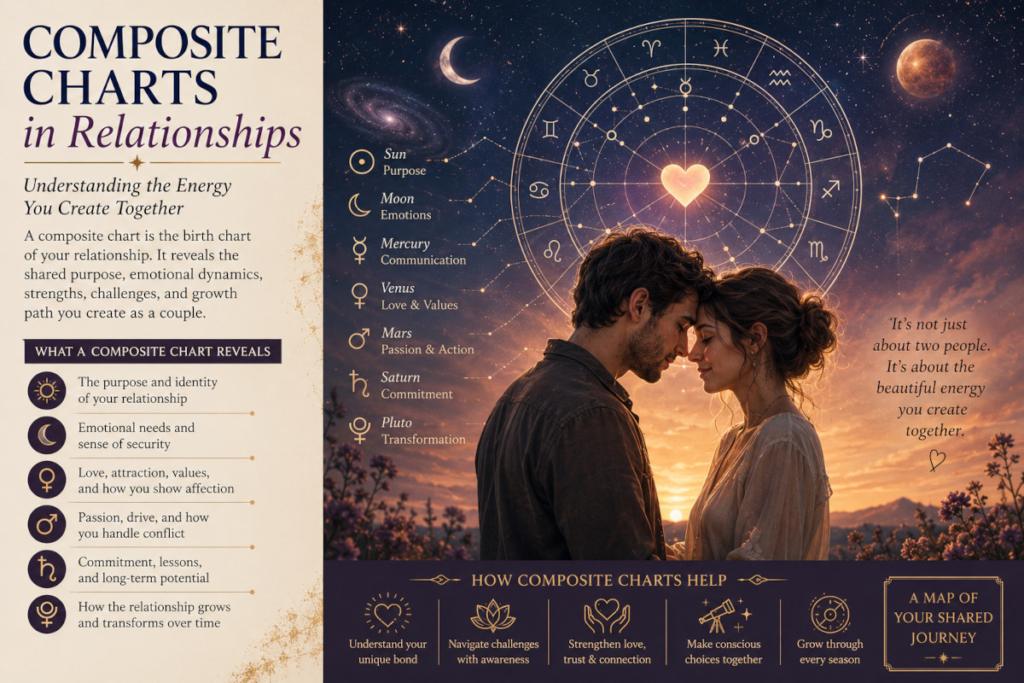
In astrology, a composite chart is often described as the birth chart of the relationship itself. It does not only show one person’s feelings or the other person’s behavior. Instead, it shows the shared energy that exists between them. It answers questions like: What kind of bond are we creating? What is this relationship here to teach us? Where do we naturally flow, and where do we need more awareness?
Composite charts are especially useful because relationships are more than individual compatibility. Two people can have strong chemistry but still struggle to build something stable. Others may not seem dramatic at first, yet together they create a deeply supportive and meaningful connection.
A composite chart helps you understand the relationship as its own living pattern.
What Is a Composite Chart?
A composite chart is created by finding the midpoint between two people’s planetary placements. These midpoint positions create one shared chart that represents the relationship as a separate energetic entity.
For example, if one person’s Sun is in one part of the zodiac and the other person’s Sun is in another, the composite Sun is placed at the midpoint between them. The same idea is used for the Moon, Mercury, Venus, Mars, and the rest of the chart.
The result is not “your chart” or “their chart.” It is the chart of the relationship.
This can feel abstract at first, but it becomes easier to understand when you think of a relationship as something that has its own life. A friendship, romantic partnership, marriage, business partnership, or family bond can all develop patterns that are bigger than either person alone.
The composite chart shows what the connection becomes when both people are involved.
Composite Chart vs. Synastry
Composite charts and synastry are both used in relationship astrology, but they answer different questions.
Synastry compares two individual birth charts. It shows how one person’s planets interact with the other person’s planets. Synastry is useful for understanding attraction, emotional triggers, communication patterns, chemistry, comfort, tension, and personal compatibility.
A composite chart creates one shared chart from both people’s placements. It shows the identity, purpose, emotional needs, challenges, and growth path of the relationship itself.
Synastry asks: How do we affect each other?
Composite asks: What are we together?
Both methods are valuable. Synastry may explain why one person feels emotionally understood or challenged by the other. The composite chart may explain why the relationship itself feels serious, playful, healing, unstable, creative, private, public, intense, or transformative.
For a complete view, it is best to consider both.
The Relationship as a Third Energy
One of the most important ideas behind composite charts is that a relationship creates a third energy.
There is one person. There is the other person. And then there is the bond they create together.
This third energy can have needs of its own. A relationship may need honesty, structure, freedom, tenderness, creativity, emotional depth, or practical commitment in order to thrive. Sometimes the needs of the relationship are different from the preferences of each individual.
For example, two people may both enjoy independence, but their composite chart may show that the relationship grows best through emotional openness and regular communication. Or two people may feel attracted to each other, but the composite chart may show that the relationship requires patience, maturity, and realistic expectations.
The composite chart does not replace personal choice. It simply shows the energetic pattern that the relationship tends to create.
The Composite Sun: The Purpose of the Relationship
The composite Sun is one of the most important placements in the chart. It shows the core identity of the relationship and what the connection is here to express.
The composite Sun can reveal the main theme of the relationship. It may show whether the bond is centered on romance, family, creativity, healing, adventure, responsibility, public success, emotional growth, or spiritual development.
A strong composite Sun can make the relationship feel meaningful and alive. Both people may sense that the connection has a clear direction or purpose. However, if the Sun is challenged, the relationship may struggle with identity. The partners may ask: What are we building? Where is this going? What does this relationship want to become?
The sign of the composite Sun describes the style of the relationship. Fire signs may create a passionate, active, inspiring bond. Earth signs may create something practical, loyal, and grounded. Air signs may bring communication, ideas, and mental connection. Water signs may create emotional depth, sensitivity, and intuition.
The house of the composite Sun shows where the relationship naturally shines.
The Composite Moon: Emotional Climate and Safety
The composite Moon shows the emotional life of the relationship. It reveals what makes the bond feel safe, nourished, and emotionally connected.
If the composite Sun is the purpose of the relationship, the composite Moon is its heart.
This placement can show how the relationship handles feelings, comfort, vulnerability, and emotional needs. Some composite Moon placements create warmth and closeness. Others may bring emotional sensitivity, mood changes, or difficulty expressing needs clearly.
A relationship with a strong composite Moon may feel emotionally familiar. The partners may easily create a sense of home with each other. But if the Moon is under pressure, emotional misunderstandings may become a repeated theme.
The composite Moon asks: What does this relationship need in order to feel emotionally secure?
For some couples, the answer is honesty. For others, it is stability, affection, shared routines, private time, family connection, or emotional reassurance.
Understanding the composite Moon can help partners care for the relationship more consciously.
The Composite Mercury: Communication as a Couple
The composite Mercury shows how the relationship thinks, talks, listens, and makes decisions.
This placement can reveal whether communication is direct, emotional, intellectual, playful, practical, intense, or confusing. It can also show how the couple solves problems together.
A strong composite Mercury can support honest conversations, shared ideas, humor, planning, learning, and mutual understanding. The relationship may feel mentally stimulating and easy to talk through.
A challenged composite Mercury may bring misunderstandings, mixed signals, overthinking, silence, criticism, or difficulty agreeing on important decisions.
Composite Mercury is especially important because even strong love needs communication. A relationship may have deep feelings, but without a healthy way to discuss needs, conflicts, and expectations, emotional closeness can become harder to maintain.
This placement asks: How does this relationship communicate when things are easy, and how does it communicate when things are difficult?
The Composite Venus: Love, Affection, and Shared Values
Composite Venus shows the love language of the relationship. It describes affection, beauty, pleasure, attraction, harmony, and the values that hold the bond together.
This placement can show what makes the relationship feel sweet, romantic, peaceful, and enjoyable. It can also reveal what both people need to appreciate and value about the connection.
A strong composite Venus may create warmth, kindness, attraction, shared taste, and emotional softness. The partners may enjoy spending time together and may naturally want to make the relationship pleasant.
A challenged composite Venus may point to differences in values, affection styles, financial priorities, or expectations around love. One partner may want more romance while the other focuses on practicality. One may need verbal appreciation while the other shows love through action.
Composite Venus asks: How does this relationship give and receive love?
When partners understand this placement, they can become more intentional about creating connection instead of assuming love should always feel effortless.
The Composite Mars: Passion, Drive, and Conflict
Composite Mars shows the energy, desire, action, and conflict style of the relationship.
This placement can reveal what motivates the couple and how they pursue goals together. It can also show how they argue, compete, handle frustration, and express passion.
A strong composite Mars can bring attraction, courage, movement, and shared ambition. The relationship may feel exciting and active. Both people may push each other to take action and grow.
A difficult composite Mars can create arguments, impatience, power struggles, or emotional reactivity. The relationship may have strong chemistry, but that same energy can become conflict if it is not handled consciously.
Composite Mars is not bad. Every relationship needs energy. Without Mars, a relationship may lack momentum. But Mars must be directed in healthy ways.
This placement asks: Does our shared energy build the relationship, or does it turn against it?
The Composite Jupiter: Growth and Possibility
Composite Jupiter shows where the relationship expands. It reveals hope, opportunity, generosity, learning, and shared meaning.
A strong composite Jupiter can make the relationship feel encouraging and optimistic. The partners may inspire each other to dream bigger, travel, study, create, take risks, or believe in new possibilities.
This placement can also show where the relationship brings abundance. That abundance may be emotional, spiritual, creative, intellectual, or material.
However, Jupiter can sometimes exaggerate. A challenged Jupiter may create unrealistic expectations, overpromising, excess, or avoiding practical details because everything feels possible in the moment.
Composite Jupiter asks: How does this relationship help both people grow?
When used wisely, Jupiter brings faith and expansion without ignoring reality.
The Composite Saturn: Commitment, Tests, and Responsibility
Composite Saturn is one of the most important placements for long-term relationships. It shows responsibility, structure, boundaries, maturity, and the lessons the relationship must learn.
Many people fear Saturn in relationship astrology, but Saturn is not only about difficulty. It is also about commitment, endurance, and building something real.
A strong composite Saturn can make the relationship serious and lasting. The partners may feel responsible for each other or committed to building a future. There may be loyalty, patience, and a willingness to work through challenges.
A difficult composite Saturn can feel heavy. The relationship may face delays, distance, fear, pressure, emotional coldness, or repeated tests. Sometimes one or both people may feel burdened by expectations.
Saturn asks for maturity. It does not allow the relationship to survive only on attraction or fantasy. It asks: Are we willing to show up consistently? Can we take responsibility? Can we create healthy boundaries? Can this relationship handle reality?
If both people are willing to grow, composite Saturn can become a source of strength.
The Composite Pluto: Transformation and Intensity
Composite Pluto shows where the relationship becomes intense, transformative, and deeply revealing.
This placement can bring powerful emotional experiences. The relationship may change both people in ways they did not expect. It may expose fears, desires, control patterns, old wounds, or hidden truths.
A strong Pluto connection can feel magnetic and life-changing. The relationship may push both people toward emotional honesty and personal evolution.
But Pluto must be handled carefully. If unconscious, it can bring control, jealousy, obsession, manipulation, or power struggles. The goal of composite Pluto is not domination. It is transformation.
This placement asks: What does this relationship force us to face?
When Pluto is used with awareness, the relationship can become a catalyst for deep healing and growth.
The Composite Ascendant: How the Relationship Appears to Others
The composite Ascendant shows the outer personality of the relationship. It describes how the couple appears to the world and how the relationship naturally begins new experiences.
Some relationships appear warm and approachable. Others seem private, intense, adventurous, elegant, unusual, serious, or playful. The composite Ascendant can show the first impression the relationship gives to other people.
It can also describe how the relationship handles new situations. Does it move quickly? Does it proceed carefully? Does it seek harmony? Does it need freedom? Does it prefer privacy?
This placement reminds us that a relationship has both an inner world and an outer expression.
Composite Houses: Where the Relationship Lives
The houses in a composite chart show the life areas where the relationship’s energy is strongest.
A 4th house emphasis may point to home, family, emotional roots, and private life. A 5th house emphasis may show romance, creativity, joy, and self-expression. A 7th house emphasis highlights partnership, commitment, and cooperation. An 8th house emphasis can bring deep emotional bonding, transformation, intimacy, and shared resources. A 10th house emphasis may make the relationship visible through career, public goals, or reputation. An 11th house emphasis may focus on friendship, community, and shared dreams.
No house is automatically good or bad. Each one shows where the relationship is most active and where both people may need to give attention.
Composite Charts for Romantic Relationships
In romantic relationships, composite charts can reveal the deeper purpose of the bond.
They can show whether the relationship is primarily romantic, emotional, creative, practical, transformational, spiritual, or commitment-oriented. They can also show where the couple may struggle.
For example, a relationship with strong composite Venus and Moon may feel loving and emotionally close. A relationship with strong Mars and Pluto may feel passionate and intense. A relationship with strong Saturn may feel serious, committed, or heavy. A relationship with strong Uranus may feel exciting but unpredictable.
The composite chart helps partners understand what kind of relationship they are actually creating, not only what they wish it would be.
Composite Charts for Friendships, Family, and Business
Composite charts are not only for romance. They can also be used for friendships, family relationships, creative partnerships, and business connections.
In friendships, the composite chart can show shared interests, emotional support, loyalty, and the purpose of the bond. In family relationships, it can reveal emotional patterns, responsibilities, and generational themes. In business partnerships, it can show communication style, shared goals, public success, structure, and potential challenges.
Any relationship that creates a meaningful dynamic can be explored through a composite chart.
The key is to interpret the chart according to the type of relationship. A strong Saturn placement may feel heavy in a romance but useful in a business partnership. A strong 5th house emphasis may bring fun and creativity to a friendship, while a strong 10th house emphasis may support professional achievement.
Composite Transits: How Relationships Change Over Time
Composite charts can also be read through transits. This means current planetary movements are compared to the composite chart to understand relationship timing.
Composite transits can show periods of growth, pressure, change, commitment, confusion, healing, or transformation.
Saturn transits may bring tests, responsibilities, or decisions about commitment. Jupiter transits may bring growth, optimism, and new opportunities. Uranus transits may bring change, restlessness, or a need for freedom. Neptune transits may bring idealism, sensitivity, or confusion. Pluto transits may bring deep transformation and emotional intensity.
Transits do not remove free will. They simply describe the kind of energy the relationship may be moving through.
A difficult transit does not mean the relationship must end. A supportive transit does not guarantee everything will be easy. But timing can help partners understand why certain themes are becoming more important.
How to Use a Composite Chart in Real Life
A composite chart is most useful when it supports awareness, not fear.
Start with the basics. Look at the composite Sun to understand the relationship’s identity. Look at the Moon to understand emotional needs. Look at Venus and Mars to understand love, attraction, and conflict. Look at Saturn to understand commitment and lessons. Look at the house emphasis to see where the relationship’s energy is focused.
Then ask practical questions:
- What does this relationship need in order to thrive?
- Where do we naturally support each other?
- Where do we repeat the same challenge?
- What kind of growth does this bond ask from us?
- Are we honoring both the relationship and our individual needs?
The best astrology is not just descriptive. It helps people make more conscious choices.
Limitations of Composite Charts
Composite charts can offer meaningful insight, but they should not be used as the only measure of a relationship.
A composite chart cannot guarantee success or failure. It cannot tell you whether someone will treat you well. It cannot replace communication, trust, boundaries, shared values, emotional maturity, or real-life behavior.
A relationship with a beautiful composite chart can still struggle if the people involved are not honest or respectful. A relationship with challenging placements can still become strong if both people are committed to growth.
Astrology should never be used to excuse harmful behavior or pressure someone to stay in a relationship that feels unhealthy. The chart shows patterns, but people make choices.
The relationship is important, but individual well-being matters too.
Common Mistakes When Reading Composite Charts
One common mistake is reading the composite chart as if it belongs to one person. It does not. It belongs to the relationship.
Another mistake is looking only at romantic placements like Venus and Mars while ignoring Saturn, the Moon, Mercury, and the houses. Love and attraction matter, but communication, emotional safety, and responsibility matter just as much.
A third mistake is assuming difficult placements are bad. Challenging aspects can create growth, depth, and resilience when handled with maturity.
It is also a mistake to use the composite chart as a final verdict. A chart can show potential, but it cannot replace lived experience.
The most useful approach is balanced: read the chart, reflect on the patterns, and compare them with the actual relationship.
Frequently Asked Questions
What does a composite chart show?
A composite chart shows the shared energy of a relationship. It can reveal the relationship’s purpose, emotional climate, communication style, love language, conflict patterns, responsibilities, and growth path.
Is a composite chart the same as synastry?
No. Synastry compares two individual birth charts and shows how two people affect each other. A composite chart creates one shared chart that represents the relationship itself.
Can a composite chart predict if a relationship will last?
A composite chart can show strengths, challenges, and commitment themes, but it cannot predict the future with certainty. A lasting relationship depends on choices, behavior, maturity, communication, and mutual effort.
Which composite placements are most important?
The composite Sun, Moon, Venus, Mars, Saturn, Mercury, Ascendant, and house emphasis are especially important. Together, they show the relationship’s identity, emotional needs, love style, conflict style, communication, and long-term potential.
Can composite charts be used for non-romantic relationships?
Yes. Composite charts can be used for friendships, family bonds, creative partnerships, and business relationships. Any connection that creates a meaningful shared dynamic can be explored through a composite chart.
Conclusion
A composite chart offers a powerful way to understand a relationship as more than two separate people. It shows the energy that forms when two lives meet and begin creating something together.
Synastry explains how two people interact. The composite chart explains what the relationship becomes.
By studying the composite Sun, Moon, Mercury, Venus, Mars, Saturn, Pluto, Ascendant, houses, and transits, you can better understand the purpose, emotional needs, strengths, challenges, and timing of a relationship.
Still, the chart is only one part of the story. A relationship is shaped by real choices, honest conversations, emotional responsibility, and the willingness to grow.
Composite charts can guide reflection, but the people inside the relationship decide how consciously the connection is lived.
When used wisely, composite astrology can help you honor not only each person, but also the unique bond created between them.